


Type: Anesthesia
Reusable Portable Video Laryngoscope | 3 Blades

Type: Anesthesia
Video Laryngoscpe with 2 Blades Disposable


Type: Medansh
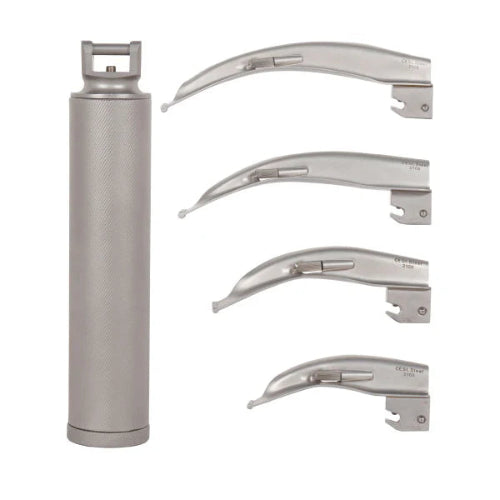
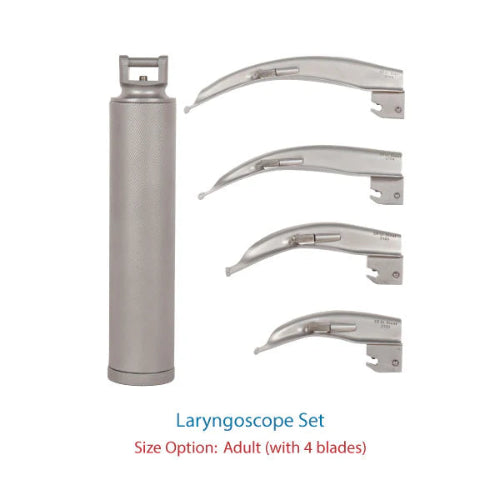
Laryngoscope Premium with Blade Size 2, 3, 4
Type: Scopes
Laryngoscope Set Blade Size 2 3 and 4 Adult Macintosh Type


Type: Medansh
Medical Portable Video Laryngoscope


Type: Anesthesia
Laryngoscope Fiber Optic LED Set Macintosh 1-4 Blades Kit


Type: Scopes
Laryngoscope Premium with Blade Size 0, 1 in Pouch
Type: Scopes
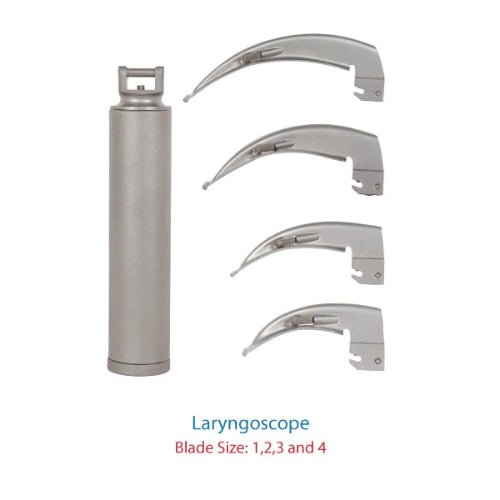
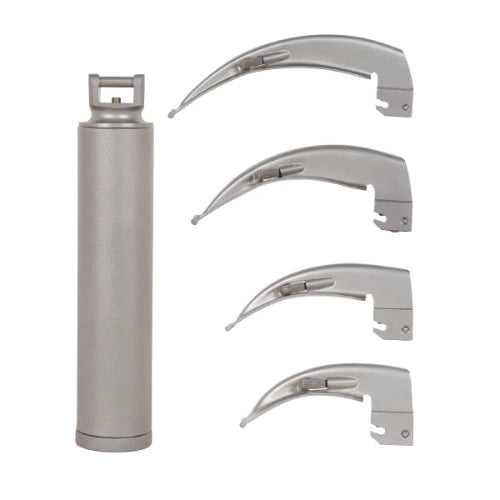
Laryngoscope Economy Blade Size 1, 2, 3, 4

Type: Medansh
Portable Video Laryngoscope


Type: Scopes
Laryngoscope Premium with Blade Size 1, 2, 3, 4
Type: Scopes
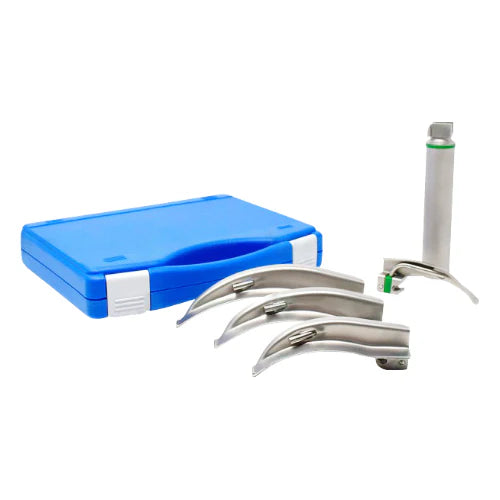
Fiber Optic LED Laryngoscope Set Macintosh 00,0,1
Type: Scopes
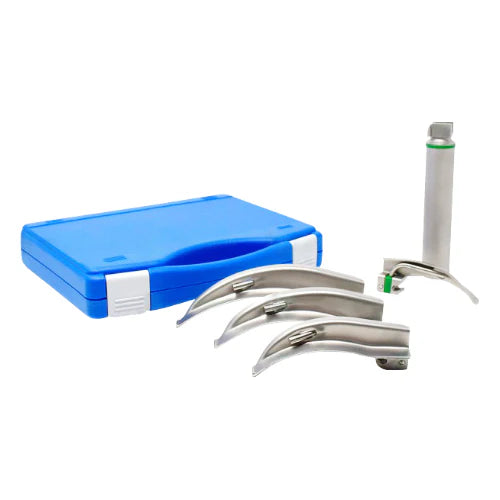
Fiber Optic LED Laryngoscope Set Macintosh 0,1, 2

Type: Scopes
Fiber Optic LED Laryngoscope Set Miller 1, 2, 3

Type: Scopes
Fiber Optic LED Laryngoscope Set Miller 00, 0, 1

Type: Scopes
Fiber Optic LED Laryngoscope Set Miller 0, 1, 2
Collection:
Types of Laryngoscopes: A Comprehensive Guide
You've seen it a hundred times in medical dramas: a team rushes to a patient's side, and a doctor grabs a lighted metal device, shouting, "We need to intubate!" That critical tool, often seen but rarely named, is a laryngoscope. For all its on-screen drama, its real-world function is to solve a surprisingly difficult and fundamental problem.
So, what is a laryngoscope actually for, and why is a special device even necessary? The answer lies in a simple but significant anatomical puzzle. Unlike a hollow pipe, the human airway is hidden behind the tongue, and the path to the lungs curves sharply downward. As doctors know all too well, you simply can't see around that corner without help.
A laryngoscope is the elegant solution to this visibility problem. This specialized medical tool to view the vocal cords has two primary functions: its flat part, called a "blade," is used not to cut, but to gently lift the tongue and soft tissue out of the way. At the same time, a bright light on its tip illuminates the path, creating a clear, direct line of sight to the windpipe's opening.
By creating this temporary window into the airway, the laryngoscope allows clinicians to safely guide a breathing tube into the lungs. This single capability is a cornerstone of modern medicine, making both routine surgeries and life-saving emergency care possible. Its function demystifies one of the most critical procedures in a hospital.
Why Can't a Doctor Just Look Down Your Throat?
If a doctor just asked you to say "ah," they would only see the very back of your throat. The real challenge lies deeper. Your tongue, a surprisingly large and strong muscle, acts like a fleshy curtain, completely blocking the view of the critical structures below. It must be physically lifted up and out of the way to create a clear line of sight for placing a breathing tube.
Beyond the tongue, your throat isn't one simple tube. Think of it as a hallway with two crucial doors at the end. One door leads to your esophagus (the 'food pipe'), which goes to your stomach. The other door opens into your trachea (the 'windpipe'), the only path to your lungs. This makes the job of visualizing the glottis for intubation---seeing the correct opening---incredibly important, as putting a tube down the wrong pipe by mistake is dangerous.
To guard this vital airway, your body has a brilliant safety feature: a small, leaf-shaped flap of cartilage called the epiglottis. You can think of it as an automatic trapdoor. When you swallow, the epiglottis snaps shut over your windpipe, directing food and drink safely toward your stomach. For a doctor, however, this protective flap is another small obstacle that must be carefully managed to see the entrance to the lungs.
A doctor faces three distinct challenges:
- lifting the tongue
- identifying the correct "door" to the lungs
- navigating around the epiglottis
A simple flashlight and tongue depressor won't work for such a complex task. It requires a specialized instrument, which is why the laryngoscope is one of the most essential airway management devices available in medicine.
What Are the Main Parts of a Laryngoscope?
To solve the twin problems of lifting the tongue and seeing in a dark space, the laryngoscope is made of two simple but sturdy parts: a handle and a blade. The handle is a thick, textured tube that the doctor holds. It's more than just a grip; it also houses the batteries that power the tool's most important feature, turning the entire device on when the blade is clicked into place.
Although it's called a "blade," this part isn't sharp and is never used for cutting. Think of it instead as a smooth, blunt lever. Its sole purpose is to be carefully inserted into the mouth to gently lift the tongue up and forward, clearing a direct line of sight to the structures deep in the throat. This is the physical work that a simple tongue depressor just can't do.
To complete the job, a small light located at the tip of the blade illuminates the path. With the handle providing power and the blade creating space, this light allows the doctor to clearly see the entrance to the windpipe.

How Doctors Use a Laryngoscope: The Classic "Direct" View
With the laryngoscope assembled and lit, the doctor performs a procedure called direct laryngoscopy. The term "direct" is the key here---it means the doctor must create a perfectly straight line from their own eye, through the patient's mouth, all the way down to the top of the windpipe. To accomplish this, they use the blade as a lever to gently but firmly lift the patient's tongue and jaw forward, physically moving tissue out of the way.
Imagine trying to look down a bent, dark pipe. You can't see the end unless you can somehow straighten the path and shine a light. That's precisely the challenge in the human airway. The doctor must skillfully position the patient's head and use the laryngoscope to create a brief, straight line of sight from the teeth to the vocal cords. This maneuver is the most physically demanding part of the process.
Once this direct view is established, the blade's light illuminates the destination: the opening to the trachea (the windpipe). This is the "right door" for the breathing tube. Seeing this clearly is the single most critical goal, as it ensures the tube is guided into the lungs and not the nearby esophagus, or food pipe.
This entire procedure requires immense skill, as the doctor must perfectly align their body, the patient, and the tool all at once. For decades, it was the only way to secure an airway. But the challenge of getting a straight line of sight in patients with difficult anatomy led to a major technological upgrade.
The Upgrade: How Video Laryngoscopes Provide a "GPS for the Airway"
That challenge---getting a clear view when a patient's anatomy creates a difficult "corner"---sparked a brilliant innovation. Instead of trying to force a straight line of sight, what if the tool could simply see around the corner for you? This is the idea behind video laryngoscopy, a major leap forward that adds modern technology to the classic laryngoscope.
A video laryngoscope looks very similar to a traditional one, but with one game-changing addition: a miniature camera, smaller than a pea, mounted right at the tip of the blade. As the blade is inserted to lift the tongue, this camera acts as the doctor's eyes, capturing a live video feed from deep inside the throat, right at the entrance to the windpipe.
This video feed is sent to a small screen attached to the handle. Suddenly, the doctor no longer needs to physically align their own eye with the patient's throat. They can simply watch the screen, which provides a bright, magnified view of the vocal cords. It's like having a GPS for the airway; the doctor can expertly navigate the breathing tube to its destination without needing a direct, straight-line view.
The benefit of this technology is immense. For patients with what doctors call a "difficult airway"---perhaps due to swelling, an injury, or unique anatomy---video laryngoscopy can make the difference between a smooth procedure and a critical struggle. It often allows for gentler, faster, and safer placement of the breathing tube. But this high-tech upgrade does not make the classic method obsolete.

Video vs. Direct Laryngoscopy: Which View Is Better?
With the high-tech advantage of a video screen, you might assume the traditional direct laryngoscope is now obsolete. However, that couldn't be further from the truth. Both tools remain essential in modern medicine, and the choice between them often comes down to selecting the right tool for a specific job. For many routine procedures in patients with straightforward anatomy, the speed and simplicity of direct laryngoscopy make it a highly effective and common choice.
The fundamental differences between the two methods come down to how the doctor sees the airway and how they use the tool. Think of it as the difference between using binoculars and a high-tech drone camera.
- The View: Direct laryngoscopy requires the doctor to create a straight line of sight from their eye to the patient's vocal cords. Video laryngoscopy displays a magnified view on a screen, eliminating the need for a direct line of sight.
- The Technique: With the direct method, the doctor must precisely align their head and body to see. The video method allows for more flexibility, as they only need to watch the monitor.
- Best For: Direct laryngoscopy is a workhorse for routine situations, while video is a game-changer for patients with a known difficult airway, for training new doctors, and for confirming the tube is in the perfect spot.
Neither tool is universally "better"---they are different solutions to the same critical challenge. An experienced doctor is skilled with both, ready to use the direct scope for its elegant simplicity or the video scope for its powerful problem-solving ability. The most important factor is always patient safety, and having more than one way to secure an airway ensures doctors are prepared for anything.
Why Would You Need a Laryngoscopy? Three Common Scenarios
- The most routine use is during general surgery. When an anesthesiologist gives you medication to put you under, it doesn't just make you unconscious; it also relaxes every muscle in your body. This includes the diaphragm and chest muscles you need to breathe. As a planned part of the procedure, the doctor uses a laryngoscope to place a breathing tube, connecting you to a machine that breathes for you safely and precisely throughout the operation.
- In stark contrast to a planned surgery is a life-or-death emergency. Following a major trauma like a car accident, a person may be unconscious and unable to keep their airway open. In other cases, like a severe allergic reaction, swelling can block the throat. In these chaotic moments, rapidly using a laryngoscope to secure the airway is one of the most important first steps to saving a life.
- Finally, a laryngoscope is crucial for patients in the hospital who are critically ill. Someone with severe pneumonia, for example, might become too weak or exhausted to breathe effectively on their own. Placing a breathing tube gives their body the rest it desperately needs to fight the illness, ensuring their blood remains supplied with vital oxygen while they heal.
Is a Laryngoscopy Considered a Surgery?
A laryngoscopy isn't considered a surgery. Instead, healthcare professionals classify it as a procedure. The key difference lies in the action: surgery typically involves making an incision to repair or remove something, while a procedure is a specific, skilled task performed for a medical purpose.
Think of the laryngoscope's "blade." Despite its name, it isn't sharp and doesn't cut. Its sole job is to gently press the tongue down and lift the jaw to create a clear path for a breathing tube. This action of clearing and viewing the airway is the procedure---a critical step, but not an operation in itself.
Therefore, a laryngoscopy is often performed as part of preparing for surgery, but it isn't the surgery itself. It's the essential task that lets a doctor secure your airway.
Will I Be Awake During a Laryngoscopy?
The answer to this question almost always depends on the reason for the procedure. If a doctor is using a laryngoscope to place a breathing tube for surgery or an emergency---the dramatic scene you see on TV---you will not be awake. Patients are either under general anesthesia (completely unconscious) or deeply sedated, so they are unaware of the procedure and feel no discomfort. The goal in this situation is to secure the airway as quickly and safely as possible while the patient is fully relaxed.
However, a laryngoscopy isn't always about placing a breathing tube. Sometimes, a doctor simply needs to get a good look at your voice box or throat to diagnose an issue like chronic hoarseness or a persistent cough. For this type of diagnostic exam, you are typically awake. These procedures, often called Indirect Laryngoscopy (using a small mirror) or Direct Fiber-Optic (Flexible) Laryngoscopy (using a thin, camera-equipped scope), are performed in a doctor's office.
To ensure your comfort during an awake procedure, the doctor will numb the back of your throat with a special anesthetic spray. While you might feel a gagging sensation briefly, the numbing agent works quickly to make the examination tolerable. So, the purpose dictates the experience: intubation requires you to be asleep, while a simple diagnostic look does not.
Is the Laryngoscopy Procedure Painful?
The procedure itself is not designed to be painful. If a laryngoscope is used to place a breathing tube, you will be under general anesthesia and feel absolutely nothing. For awake examinations in a doctor's office, a numbing spray is used to deaden the sensation in your throat. While you might feel pressure or a gag reflex before the anesthetic kicks in, you should not feel any sharp pain.
What you are more likely to experience is some discomfort afterward . The most common side effect is a sore throat, similar to what you might feel with a cold. This happens because the instrument has to gently move the tongue and other soft tissues to get a clear view. A sore throat after intubation is very normal and is simply a sign that your throat tissues are a bit irritated from the process.
This discomfort is usually mild and fades within a day or two. Doctors often recommend simple remedies like sucking on ice chips or throat lozenges to help soothe it. While a sore throat is a common and minor issue, other potential risks should be considered.
What Are the Risks of a Laryngoscopy?
When considering the risks of a laryngoscopy procedure, it's helpful to think like a doctor, who weighs the potential risks against the definite benefits. In nearly every case where a laryngoscope is needed, the goal is to secure an airway---a life-saving action. The small possibility of a complication is measured against the certainty of what happens if a person cannot breathe. From that perspective, the benefits are immense.
Beyond the common sore throat, the other potential issues are generally minor. Some people experience a hoarse voice for a day or two, and there can be minor bruising or scrapes to the lips or inside of the mouth. These discomforts are temporary and resolve on their own as the tissue heals from being moved and manipulated during the procedure.
A much less common, but more well-known risk, is damage to the teeth. Because the traditional laryngoscope is a rigid metal instrument, there is a small chance of chipping a tooth if it makes contact. This is precisely why anesthesiologists are highly trained in careful technique. They use anesthesiologist intubation tools with skill and precision, consciously protecting the teeth as they gently lift the tongue to get the view they need.
Ultimately, while no medical procedure is entirely without risk, laryngoscopy is considered a very safe and routine intervention. The serious complications are rare, and clinicians are trained specifically to avoid them. The design of the tool itself is a major factor in improving safety and success.
A Closer Look at the Blade: Why Shape and Size Matter
Looking at a laryngoscope, you might think one shape fits all. But the human body is incredibly diverse, and so are the tools designed to work with it. The most crucial part, the blade, actually comes in two primary forms, as you can see in the image. Among the different types of laryngoscope blades, the most common are either gently curved or perfectly straight. This choice isn't random; it depends on a patient's unique anatomy and the doctor's specific technique. Each shape provides a slightly different angle and method for lifting the tongue to create a clear path to the windpipe.
Beyond the shape, size is equally critical. A blade designed for a large adult would be unsafe for a child, let alone a newborn baby whose throat is incredibly small and delicate. For this reason, laryngoscope blade sizes range from tiny versions for premature infants to much larger ones for adults. Clinicians use a system, often guided by a laryngoscope blade size chart, to select the appropriate blade based on a patient's age and weight, ensuring the tool is a perfect and safe fit for the job every time.
Ultimately, having a variety of blade shapes and sizes is fundamental to modern medical safety. This adaptability allows professionals to place breathing tubes in virtually anyone, from an infant in a neonatal unit to an adult in the emergency room. By selecting the precise tool for the individual, clinicians can perform this critical procedure with greater success and confidence. Ensuring the tool is perfectly sterile is just as vital as choosing the right one.

How Medical Staff Keep Laryngoscopes Safe and Clean
Placing a tool deep inside a patient's throat requires absolute certainty that it is perfectly clean. To eliminate any risk of passing germs between patients, many hospitals and paramedics rely on single-use, disposable vs reusable intubation blades. These are often made of medical-grade plastic, come in a sterile peel-pouch, and are thrown away immediately after one use. This guarantees a brand-new, sterile blade for every single patient.
For the durable metal blades, the process is just as rigorous. Reusable tools undergo a strict, multi-step sterilization process after every use. This isn't just simple washing; it involves high-pressure steam, specialized chemicals, or other hospital-grade methods designed to destroy every trace of bacteria and viruses. This ensures the reusable equipment is as safe and sterile as a brand-new disposable one.
Whether a blade is disposable or reusable, safety is the top priority. The handle of the laryngoscope is also thoroughly disinfected between uses, ensuring the entire laryngoscope set is ready for the next patient.
After the View: Placing the Life-Saving Breathing Tube
- Getting that clear view is the first, crucial hurdle. The laryngoscope itself doesn't deliver oxygen; its primary purpose is to act as a guide. It holds the tongue and other tissues out of the way so the medical provider can see the entrance to the windpipe. With the path lit up and open, they can perform the main event: intubation . This is the formal name for placing a flexible, hollow plastic tube, called an endotracheal tube, directly into the patient's airway.
- With the path cleared, the doctor carefully guides the tip of the endotracheal tube past the vocal cords and into the trachea (the windpipe). This step of performing an endotracheal intubation requires incredible precision. Think of the throat as a hallway with two doors: one leading to the stomach (the esophagus) and the correct one leading to the lungs (the trachea). The direct view provided by the laryngoscope ensures the tube goes through the right door.
- Once the endotracheal tube is safely in the windpipe, the laryngoscope's job is done. The doctor carefully withdraws the blade, leaving the breathing tube in position. To ensure it doesn't move, the tube is taped securely to the patient's mouth or held with a special strap. A small cuff, like a tiny balloon around the tube, is then inflated inside the trachea to create a gentle seal. At this point, the process of securing an airway is complete, and the patient can be connected to a machine that breathes for them.
Why "Securing an Airway" Is Medicine's Top Priority
Placing a breathing tube is an intense procedure, but the urgency is critical. While a person can survive for weeks without food and days without water, the clock for oxygen is measured in mere minutes. The brain is incredibly sensitive to this loss. After just a few minutes without a steady oxygen supply, brain cells can begin to suffer irreversible damage, a devastating outcome that doctors work tirelessly to prevent.
This is why securing an airway is important ---it's often the top priority in any life-threatening emergency. When a patient can't breathe on their own, medical teams are in a race against that rapidly shrinking timeline. The challenge of managing a difficult airway, where a patient's anatomy makes placing a tube tricky, becomes a high-stakes problem that must be solved in seconds, not minutes.
A secured breathing tube, therefore, is more than plastic; it's a physical lifeline. It creates an unobstructed highway for oxygen, bypassing whatever is stopping the patient from breathing. Every one of an anesthesiologist's intubation tools, especially the laryngoscope, exists to establish that lifeline as quickly and safely as possible, turning a moment of crisis into a controlled medical situation.
The Simple Tool That Makes Modern Medicine Possible
The frantic shout to "intubate!" in a medical drama is more than just chaos; it signals the need to solve a core anatomical challenge. The human airway is a hidden, critical pathway that must be secured, and seeing around the corner of the tongue requires a purpose-built tool to gently clear a line of sight.
This is the elegant function of the laryngoscope. Whether a clinician uses a traditional direct blade or a more advanced video scope, the fundamental job is the same: to provide a clear view of the vocal cords for placing a breathing tube. From routine surgeries to life-or-death emergencies, this instrument makes modern medical interventions possible by establishing a secure airway when patients cannot do so for themselves. The laryngoscope transforms a moment of potential crisis into one of precise, life-saving action.
Laryngoscope : Q&A
Question: Why is a laryngoscope necessary---can't a doctor just look down the throat?
Short answer: Because the airway is hidden behind the tongue and curves downward, you can't see the vocal cords by simply saying "ah." A laryngoscope lifts the tongue and soft tissues and shines light to create a direct view of the glottis, helping the doctor identify the windpipe (not the esophagus) and guide the breathing tube safely.
Question: What's the difference between direct and video laryngoscopy---and which is better?
Short answer: Direct laryngoscopy requires a straight line of sight from the doctor's eye to the vocal cords, achieved by lifting the tongue and aligning the head and neck. Video laryngoscopy uses a tiny camera on the blade tip to display a magnified view on a screen, letting the doctor "see around the corner." Neither is universally better: direct is fast and effective for many routine cases, while video is especially helpful for difficult airways, training, and confirming perfect tube placement.
Question: Will I be awake for a laryngoscopy, and will it hurt?
Short answer: For intubation during surgery or emergencies, you're under general anesthesia or deep sedation and won't feel the procedure. For office-based diagnostic exams (indirect mirror or flexible fiber‑optic laryngoscopy), you're typically awake with throat-numbing spray; you may briefly gag, but it shouldn't be painful. Afterward, a mild, short-lived sore throat is common.
Question: What are the main risks of laryngoscopy?
Short answer: The most common effects are temporary---a sore throat, mild hoarseness, or minor lip/mouth scrapes. Rarely, teeth can be chipped with rigid metal blades, which is why anesthesiologists use careful technique to protect them. Overall, laryngoscopy is considered very safe, and its life-saving benefits in securing an airway far outweigh the small risk of complications.
Question: Why do blade shape and size matter?
Short answer: Blades come in two primary shapes---curved and straight---each offering a slightly different way to lift the tongue and view the windpipe, chosen based on patient anatomy and clinician technique. Sizes range from tiny blades for premature infants to larger adult sizes; clinicians use age- and weight-guided size charts to select a blade that fits safely and effectively.