
Filter
2 products
Type: General Instruments
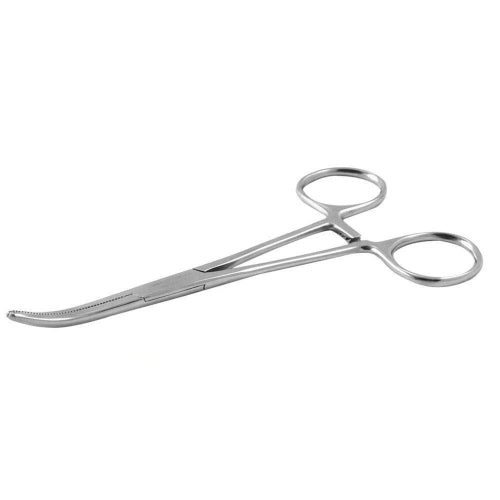
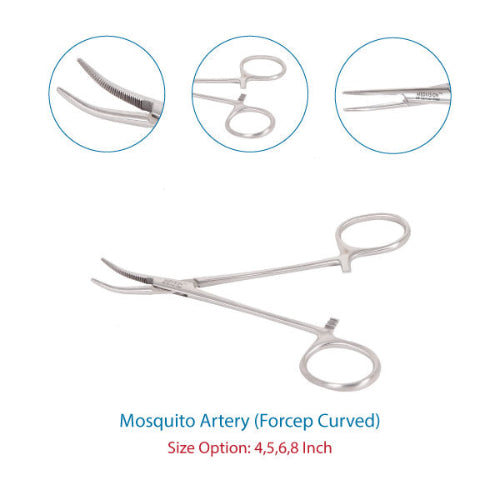
Mosquito Artery Forceps Curved 8 inch
Type: General Instruments
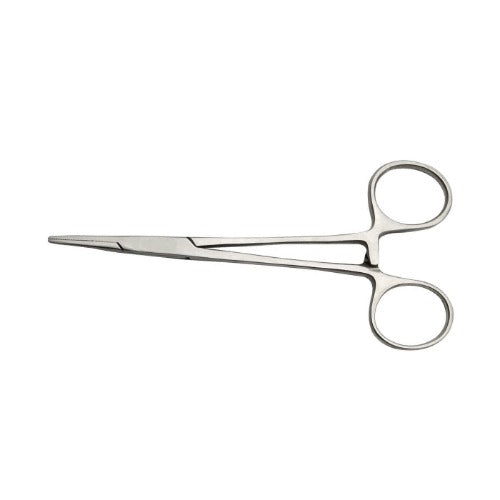
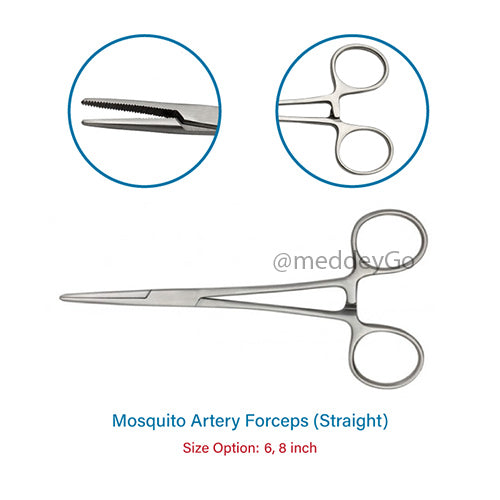
Mosquito Artery Forceps Straight
Collection:
Mosquito Artery Forceps: Uses, Parts, Diagram Logic, and Complete Guide
Introduction: Why Mosquito Artery Forceps Matter in Surgery
Mosquito artery forceps are among the most important fine hemostatic instruments in surgery because they are designed for one of the most basic but essential jobs in any procedure: controlling bleeding from small blood vessels while also helping with delicate tissue handling. Even though the instrument looks simple at first glance, it plays a vital role in many surgical, clinical, dental, veterinary, and minor-procedure settings.
The mosquito artery forceps are often associated with the name Halsted mosquito forceps. In practical instrument language, people may call them mosquito artery forceps, mosquito hemostats, mosquito forceps, or simply small artery forceps. These names all point toward the same broad instrument family: a small, fine hemostatic clamp used for precise work in limited space.
The reason this instrument is searched so often is that it appears in almost every surgical instrument set, but learners and buyers often want to understand the details more clearly. They want to know what mosquito forceps are used for, why they are called mosquito forceps, how they differ from larger artery forceps, what the parts are, and what a mosquito artery forceps diagram would usually show. These are all practical questions because the instrument is both common and easy to confuse with other hemostats.
Current instrument pages consistently describe mosquito artery forceps as small hemostatic forceps used to clamp small blood vessels and delicate tissues, with ring handles, ratchet locks, and fine serrated jaws. Straight and curved variants are both common, and product pages frequently show common overall lengths around the 12–14 cm range, with smaller and larger versions also available.
This article explains what mosquito artery forceps are, what they are used for, how their design works, what their main parts are, what a diagram would show, how they differ from larger hemostats, and how hospitals and instrument buyers should select them properly.
Surgery & Minor Procedures
Useful for clamping small vessels, controlling bleeding, and handling delicate tissues in confined spaces.
Medical Education
Important in anatomy and surgical instrument learning because it is one of the basic fine hemostatic clamps.
Instrument Procurement
Relevant for comparing straight vs curved, size options, jaw design, and overall build quality.
What Are Mosquito Artery Forceps?
Mosquito artery forceps are small hemostatic clamps designed for precise control of bleeding from small blood vessels and for handling delicate tissues during procedures. They are a type of artery forceps or hemostat, but they are much finer and more delicate than larger forceps such as Spencer-Wells or Kelly-type instruments.
Current instrument pages describe Halsted mosquito forceps as fine hemostats with small serrated jaws, typically available in straight or curved forms, with a ratchet lock that allows the jaws to stay closed at controlled pressure. This makes them ideal for precise work in smaller operative fields.
The name “mosquito” comes from the slender, fine appearance of the instrument. It is much smaller and lighter than larger artery forceps, which makes it useful in delicate work where bulky instruments would be less appropriate.
Simple Definition
Mosquito artery forceps are small, fine hemostatic clamps used to control bleeding from small blood vessels and handle delicate tissues.
Mosquito Forceps Uses
The most searched topic in this category is mosquito forceps uses. The primary use of mosquito artery forceps is to clamp small blood vessels during procedures so bleeding can be controlled. This helps maintain a clearer surgical field and supports safer, more organized tissue handling.
Current surgical instrument pages consistently describe their main uses as:
- Clamping small blood vessels to control bleeding
- Holding delicate tissue gently
- Working in narrow or confined operative fields
- Supporting fine dissection and precise manipulation
- Providing secure grasp through serrated jaws and locking ratchet
Some product and educational pages also mention use in laboratory or research settings because the fine jaws and controlled locking mechanism are useful for handling small structures. This does not change the core identity of the instrument: it remains first and foremost a fine hemostatic clamp.
Small Vessel Clamping
The classic use is temporary occlusion of small blood vessels during procedures.
Delicate Tissue Handling
Its fine jaws make it more suitable for precise tissue work than larger hemostats.
Work in Confined Space
The slim design allows more precise use in tight or narrow operative areas.
Controlled Locking
The ratchet system lets the surgeon maintain pressure without constant hand squeezing.
Mosquito Artery Forceps Uses in Surgery
In surgery, mosquito artery forceps are used when a larger artery forceps would feel too heavy, too wide, or too blunt for the task. Their fine tips and controlled gripping action make them particularly useful in delicate operations and in procedures where accurate handling matters more than large clamping force.
Current educational and product references describe mosquito forceps as ideal for small blood vessels and delicate procedures such as plastic or pediatric-type fine work, though they are also useful in many general surgical contexts. Straight versions may be chosen when direct approach is easier, while curved versions can help with visualization and maneuverability around tissue planes.
This makes the instrument a basic part of minor surgery sets, fine dissection sets, and delicate operating trays where precision matters.
Surgical Logic
Mosquito artery forceps are chosen when fine, gentle, and precise clamping is more important than the heavier grip of a larger artery forceps.
Why They Are Called Small Artery Forceps
The phrase small artery forceps is often used because mosquito forceps belong to the broader family of artery forceps, but they are among the smaller and finer members of that family. Their size makes them especially suitable for small vessels rather than major vascular control.
In traditional instrument teaching, artery forceps are classified by size and pattern. Mosquito forceps are generally introduced as the smaller fine pattern, while larger clamps such as Kelly or Spencer-Wells occupy bigger instrument categories. Educational slide references and instrument guides also commonly list mosquito or Halsted under the “small” forceps category.
This is why the names “mosquito artery forceps” and “small artery forceps” often overlap in casual teaching language.
Mosquito Artery Forceps Parts
To understand the instrument properly, it helps to know its main parts. A mosquito artery forceps diagram would typically show the same basic parts found in many ring-handled hemostatic clamps, but in a smaller and finer pattern.
The main parts include:
- Finger rings for controlled grip
- Shanks connecting the handles to the working end
- Box lock or hinge joint
- Ratchet lock for self-retaining clamping
- Jaws with fine serrations
- Tips at the distal end for precise clamping
Current instrument discussions on hemostatic forceps consistently mention ring handles, ratchet locking, and serrated jaws as core design features. That means the mosquito artery forceps diagram is not complicated, but each part has a very practical role in precision work.
| Part | Main Role | Why It Matters |
|---|---|---|
| Finger Rings | Instrument handling and control | Allow stable grip and precise movement |
| Shanks | Transmit force from hand to jaws | Influence control and reach |
| Box Lock | Hinge mechanism | Lets the two arms move smoothly and stay aligned |
| Ratchet | Self-locking mechanism | Keeps the clamp closed without continuous hand pressure |
| Jaws | Clamping surface | Fine serrations provide grip on vessels or tissue |
| Tips | Precise working end | Permit accurate placement on small structures |
Mosquito Forceps Diagram: What It Usually Shows
A mosquito forceps diagram or mosquito artery forceps diagram usually focuses on the structural parts of the instrument and how they contribute to function. Since the instrument is quite compact, the diagram often emphasizes the ring handles, ratchet, box lock, and fine serrated jaws.
In teaching contexts, a diagram may also compare straight and curved mosquito forceps, showing how the working tip orientation changes but the general design remains the same. That comparison is useful because many learners first think straight and curved are different instruments, when in reality they are variations of the same instrument family.
A practical mosquito forceps diagram would therefore typically label:
- Finger rings
- Ratchet lock
- Box lock hinge
- Shanks
- Serrated jaws
- Straight or curved distal tip pattern
This kind of diagram is mainly useful for students, nursing learners, OT technicians, and procurement trainees who want to match the instrument name to the visible parts.
Diagram Learning Tip
A mosquito artery forceps diagram is most useful when it helps the learner connect the ratchet, hinge, and fine jaws to the instrument’s actual hemostatic function.
Straight vs Curved Mosquito Artery Forceps
Mosquito artery forceps are commonly available in both straight and curved versions. Current product pages repeatedly show both variants, which confirms that this is one of the most basic buying choices in the category.
Straight mosquito forceps are often preferred when the surgeon wants a direct linear approach. Curved mosquito forceps can be more useful when visibility, angle, or maneuvering around tissue planes matters. In many operating sets, both straight and curved versions are kept because each has practical value depending on the procedure.
The difference is therefore not about “better” or “worse.” It is about approach angle and handling preference.
Straight Pattern
Often useful when the approach is direct and the surgeon wants straightforward tip alignment.
Curved Pattern
Useful when working around tissue planes or where angled visibility is more convenient.
Same Basic Function
Both are fine hemostatic clamps for small vessels and delicate tissue work.
Tray Choice
Many instrument sets include both because different cases benefit from different tip orientation.
Common Sizes of Mosquito Artery Forceps
Although mosquito artery forceps are known as small instruments, they are not made in only one size. Current product pages show several length options, often around 12.0 cm, 12.5 cm, 14 cm, and larger variants in some manufacturers’ catalogs. Smaller micro-mosquito patterns are also described in some educational pages.
This size variation matters because a surgeon or buyer may want:
- A standard 12–12.5 cm instrument for general fine use
- A slightly longer pattern for better reach
- A micro or baby mosquito pattern for very delicate work
Even within the mosquito family, the correct length depends on the field size, visibility needs, and procedural context.
Mosquito Artery Forceps vs Kelly or Larger Artery Forceps
A common beginner mistake is assuming all ring-handled artery forceps are basically the same except for size. In practice, the size difference changes the instrument’s feel and best use considerably. Mosquito forceps are finer, lighter, and more delicate than larger hemostats such as Kelly or larger general artery forceps.
Current educational pages describe mosquito forceps as ideal for small vessels and delicate procedures, while larger hemostats are intended for broader or tougher clamping tasks. That means mosquito forceps are better when precision matters more than heavy grasping power.
This is why hospitals and instrument buyers should stock mosquito forceps separately rather than treating them as optional mini-versions of larger clamps.
Selection Reminder
Mosquito artery forceps are not just smaller Kellys. Their fine-jaw design makes them a distinct precision instrument for delicate clamping work.
Material and Build Quality Considerations
Like most surgical instruments, mosquito artery forceps are commonly made from surgical stainless steel. Current product pages emphasize features such as fine serrated jaws, ring handles, ratchet lock mechanisms, and premium stainless steel construction. These details matter because a fine hemostatic instrument depends heavily on alignment, smooth hinge movement, consistent jaw closure, and reliable locking action.
A poorly made mosquito forceps may look correct from a distance but perform badly if the tips do not align, if the ratchet is weak, or if the hinge movement is rough. For a fine instrument, these problems are much more noticeable than in larger, rougher tools.
That is why build quality should matter in procurement, especially in settings where the instruments are used repeatedly and reprocessed.
How Hospitals and Buyers Should Choose Mosquito Artery Forceps
Choosing mosquito artery forceps should not be treated as a trivial purchase decision just because the instrument is small. Good procurement depends on matching the instrument to the clinical need. A department doing minor surgery or fine dissection work may need both straight and curved patterns, and possibly more than one length.
Good buying questions include:
- Do we need straight, curved, or both?
- Is the usual preferred size 12 cm, 12.5 cm, or 14 cm?
- Are the jaws finely serrated and well aligned?
- Does the ratchet lock firmly and smoothly?
- Is the instrument made from good surgical stainless steel?
- Do we need standard mosquito or micro-mosquito patterns?
These questions are especially useful for hospitals, minor OT setups, dental clinics, teaching labs, and instrument sellers who want to stock the right pattern rather than just any small clamp.
For OTs
Useful as a standard fine hemostatic instrument for small vessel work.
For Teaching Sets
Important because learners often first recognize artery forceps through the mosquito pattern.
For Buyers
Should compare size, curve pattern, jaw alignment, and locking quality.
For Clinics
May be very useful where delicate, precise clamping is more common than heavy vessel control.
Frequently Asked Questions
What are mosquito artery forceps?
They are small hemostatic clamps used to control bleeding from small blood vessels and handle delicate tissues.
What are mosquito forceps used for?
They are mainly used for clamping small vessels, controlling minor bleeding, and supporting delicate tissue handling during procedures.
Why are they called small artery forceps?
Because they belong to the artery forceps family but are among the smaller, finer patterns used for precise work.
What does a mosquito forceps diagram show?
It typically shows the finger rings, shanks, ratchet, box lock, serrated jaws, and the straight or curved fine tips.
What are the main parts of mosquito artery forceps?
The main parts are the finger rings, shanks, box lock, ratchet lock, jaws, and fine tips.
Are mosquito artery forceps available in straight and curved forms?
Yes. Current product pages consistently show both straight and curved versions.
What is the common size of mosquito artery forceps?
Common sizes are often around 12 to 14 cm, though smaller micro versions and larger patterns also exist.How are mosquito forceps different from larger artery forceps?
They are finer, lighter, and designed for small vessels and delicate work rather than broader heavy clamping.
Conclusion
The mosquito artery forceps may be small in size, but they are one of the most important fine hemostatic instruments in medicine. Their value comes from precision: fine serrated jaws, a stable ratchet lock, controlled handling, and the ability to clamp small vessels in delicate fields where larger forceps would feel too heavy. Whether a learner is trying to understand a mosquito forceps diagram, a buyer is comparing small artery forceps, or a clinic is selecting fine hemostatic instruments, the key point stays the same: mosquito artery forceps are built for delicate clamping and careful control. Understanding their uses, parts, and variations makes instrument choice much clearer.