


Type: Devices
Omron Portable Nebulizer NE-U200 for Home and Travel
Type: Home Healthcare
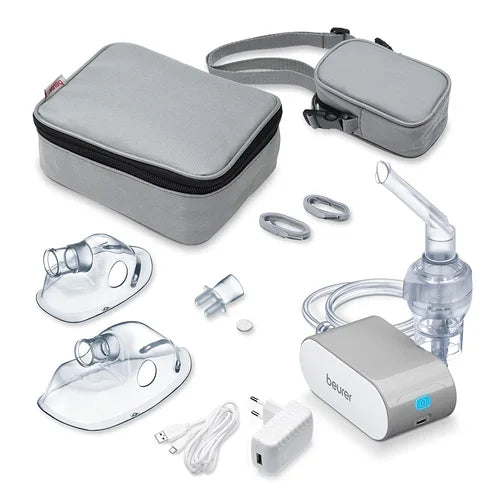
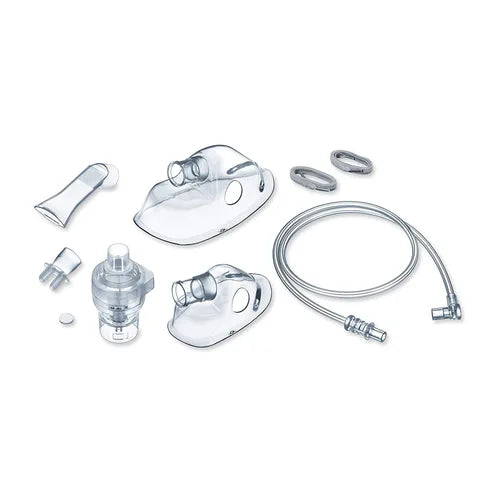
Beurer Nebulizer with 0.25 ml per min capacity and German Technology
Type: Home Healthcare
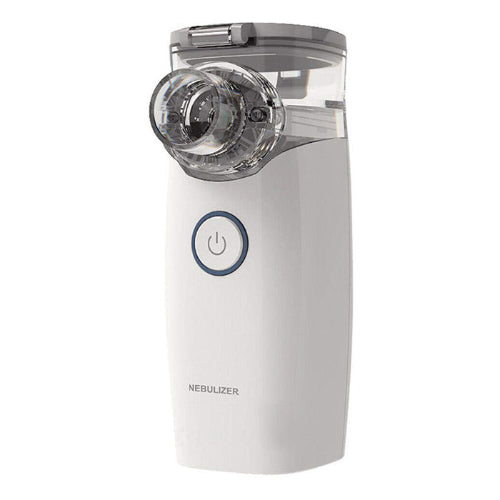
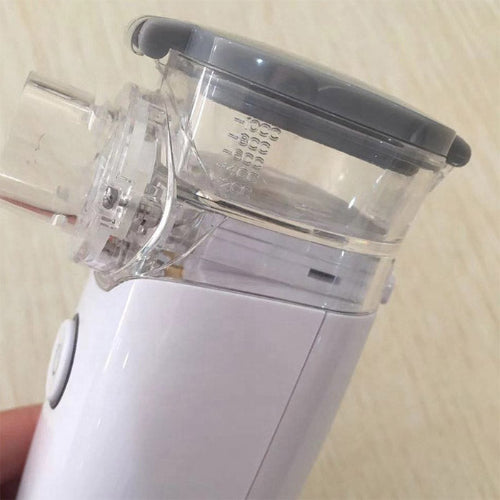
Cool Mist Ultrasonic Mesh Nebulizer Nebulizer with Rechargeable Batteries
Type: General Accessories
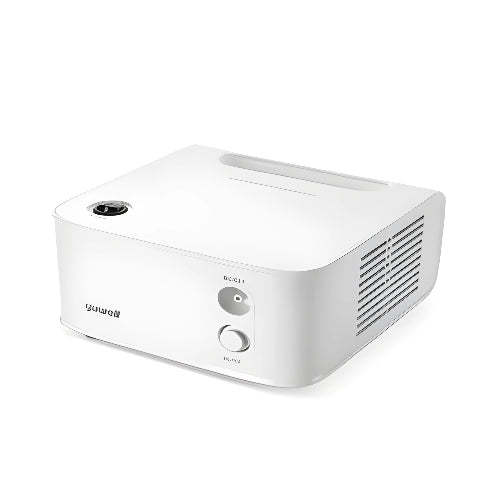
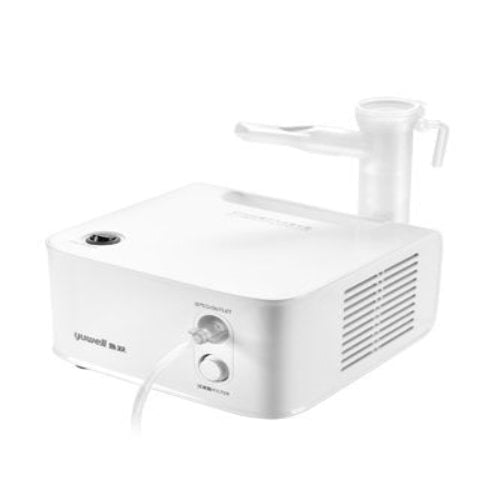
Heavy Duty-Piston Compressor Nebulizer For Hospital Use from Yuwell


Type: Anesthesia Products
Nebulizer T Piece Kit for Oxygen & Respiratory Therapy
Type: Home Healthcare
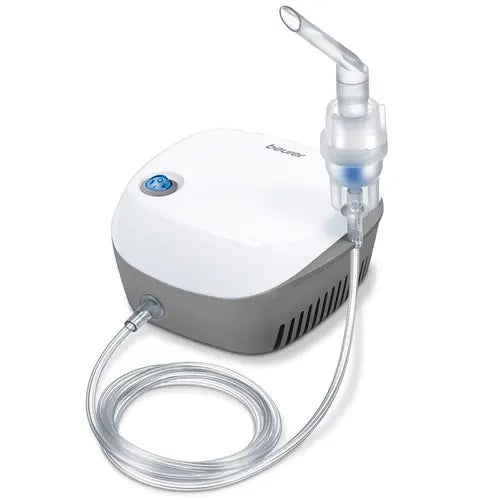
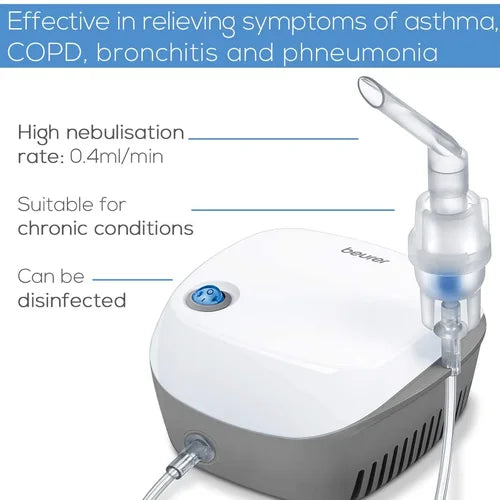
Beurer Nebulizer with 2 Masks Made in Germany


Type: Patient Room
Omron Nebulizer NE-U780 Ultrasonic Machine
Type: Home Healthcare
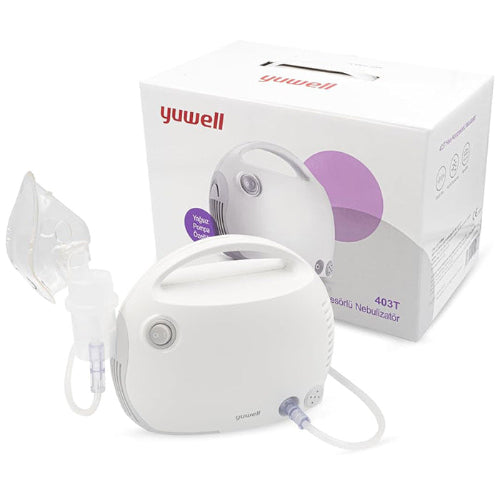
Heavy Duty Compressor Nebulizer Yuwell 403T


Type: Respiratory
Nebulizer Mask Kit Premium Quality for Respiratory Therapy
Collection:
Nebulizer Machine Guide: Uses, Types, Price & Safety
Nebulizer Machine Guide: Uses, Types, Price & Safety
A complete guide to nebulizer machine uses, medicine delivery, compressor and portable models, safety precautions, cleaning, mucus support and important factors affecting nebulizer prices in India.
Introduction: Why Nebulizer Machines Matter in Respiratory Care
A nebulizer machine is an important respiratory-care device used to convert prescribed liquid medicine into a fine aerosol mist. This mist can be inhaled through a face mask or mouthpiece, allowing respiratory medicine to travel into the airways during normal or controlled breathing.
Nebulizers are commonly used in hospitals, clinics, emergency departments, respiratory-care centres and selected home-care situations. They may be recommended for patients who cannot use a conventional inhaler correctly, need a liquid respiratory formulation or require medicine delivery over several minutes.
Many users also call the device an inhaler machine, breathing machine or nebuliser machine. However, a nebulizer is not simply a larger version of a handheld inhaler. The two devices can deliver similar categories of respiratory medicine, but their method, treatment time and user technique are different.
A nebulizer changes liquid medicine into mist, while a handheld inhaler usually releases a measured dose within seconds. A nebulizer may be easier for young children, adult patients or people who cannot coordinate pressing and breathing correctly. Still, the most suitable device depends on the diagnosis, prescription and patient’s ability.
This MeddeyGo guide explains what a nebulizer machine is used for, how it works, the difference between compressor, mesh and ultrasonic models, whether nebulization is safe for the lungs, whether it can be used for cough, how it may support mucus clearance and what affects nebulizer machine price in India.
Home Respiratory Care
Useful for prescribed respiratory treatment at home when the patient has received clear medicine and operating instructions.
Hospitals & Clinics
Used in emergency, respiratory, paediatric and general clinical settings for selected inhaled medicine delivery.
Travel & Portable Care
Compact mesh or battery-operated models may support patients who require prescribed nebulization away from home.
What Is a Nebulizer Machine?

A nebulizer is an electrical, battery-powered or rechargeable device that changes compatible liquid respiratory medicine into aerosol droplets. Aerosol droplets are extremely small particles of liquid that can remain suspended in air and be inhaled into the respiratory tract.
A standard compressor nebulizer generally includes a main compressor, air tube, medicine chamber, face mask, mouthpiece and air filter. The prescribed liquid is placed inside the chamber. The machine then creates airflow that converts the liquid into mist.
The patient normally sits upright and breathes the mist through a mask or mouthpiece. Treatment continues until the prescribed medicine is delivered or until the machine begins producing less mist, according to the product instructions.
Simple Definition
A nebulizer machine converts prescribed liquid respiratory medicine into an inhalable mist that enters the airways through a mask or mouthpiece.
What Is a Nebulizer Machine Used For?
The main purpose of a nebulizer machine is to deliver prescribed respiratory medication into the airways. The exact benefit depends on the medicine placed inside the chamber. The machine itself does not treat asthma, cough or mucus unless the liquid being delivered is suitable for that condition.
A healthcare professional may recommend nebulization when a patient has difficulty coordinating an inhaler, requires a specific liquid formulation or needs a gradual aerosol treatment.
- Delivering prescribed bronchodilator medicine
- Supporting selected asthma treatment routines
- Providing respiratory medicine for some COPD patients
- Administering sterile saline for selected airway-care needs
- Helping children inhale medicine through a paediatric mask
- Supporting adult patients with limited inhaler coordination
- Providing medicine during selected clinical or emergency workflows
Airway Medicine Delivery
Converts prescribed liquid medicine into mist that can be inhaled into the respiratory tract.
Normal Breathing
Many patients can inhale the treatment through normal breathing without complex coordination.
Child and Adult Use
Different masks and accessories may support paediatric and adult treatment requirements.
Home and Clinical Use
Nebulizers may be used in homes, clinics, hospitals and respiratory-care environments.
Nebulizer Use for Asthma
Asthma can cause airway narrowing, inflammation, wheezing, coughing and chest tightness. A doctor may prescribe nebulized medicine for selected asthma patients, especially when the patient cannot use a handheld inhaler effectively.
Children and adult patients may find it easier to breathe normally through a mask than to coordinate an inhaler. In other situations, an inhaler used with a spacer may be equally suitable or more convenient.
Patients should not automatically increase nebulizer sessions during worsening asthma symptoms. Repeated need for relief medicine may indicate poor asthma control and should be reviewed professionally.
Nebulizer Use for COPD
Chronic obstructive pulmonary disease may cause persistent breathlessness, coughing, airway obstruction and mucus production. Some COPD patients may receive prescribed bronchodilator or other respiratory medicine through a nebulizer.
The machine may be used at home, in clinics or during hospital care, depending on the patient’s treatment plan. A nebulizer should not replace oxygen guidance, clinical assessment or emergency care when symptoms become severe.
Treatment Rule
A nebulizer is only a delivery system. Medicine selection, dosage and treatment frequency should be decided according to the patient’s diagnosis and prescription.
Nebulizer Use for Children and AdultPatients
Children may find it difficult to coordinate pressing an inhaler and breathing at the correct time. A paediatric face mask allows a child to breathe normally while the machine delivers mist.
The mask should fit properly over the nose and mouth without large gaps. A loose mask may allow medicine mist to escape and reduce effective delivery.
Adult patients may have reduced hand strength, limited inhalation force, memory problems or difficulty following inhaler technique. A nebulizer may simplify medicine delivery, although the patient’s heart condition, other medicines and full medical history should still be considered.
Paediatric Use
A correctly sized child mask can support medicine delivery when a child cannot use a mouthpiece or inhaler properly.
Adult Use
Adults may use a mouthpiece or face mask depending on treatment instructions and their ability to maintain a seal.
Senior-Care Use
A nebulizer may simplify respiratory treatment for adult patients with limited coordination or inhalation strength.
Main Parts of a Nebulizer Machine
A nebulizer is made of several connected components. Each part has an important function in converting medicine into mist and delivering it to the patient.
| Nebulizer Part | Main Function | Care Requirement |
|---|---|---|
| Compressor Unit | Creates the airflow required by a jet nebulizer. | Keep dry, clean and away from water. |
| Medicine Chamber | Holds the prescribed liquid during treatment. | Clean and air-dry according to the manual. |
| Air Tube | Carries airflow from the compressor to the chamber. | Check for cracks, bends and moisture. |
| Face Mask | Allows inhalation through the nose and mouth. | Use the correct size and avoid sharing. |
| Mouthpiece | Allows aerosol inhalation through the mouth. | Clean after use and keep patient-specific. |
| Air Filter | Supports suitable airflow into the compressor system. | Replace when dirty or as advised. |
How Does a Nebulizer Machine Work?
A nebulizer works by converting liquid medicine into fine aerosol particles. The method depends on the technology used inside the device.
A compressor nebulizer uses air pressure. A mesh nebulizer uses a vibrating membrane with very small openings. An ultrasonic nebulizer uses high-frequency vibration.
- Prescribed liquid is added to the medicine chamber.
- The chamber is connected to the machine.
- A mask or mouthpiece is attached.
- The machine is switched on.
- The liquid changes into aerosol mist.
- The patient inhales the mist for the prescribed duration.
- The machine is switched off and approved accessories are cleaned.
Types of Nebulizer Machines
Nebulizers are available in several technologies. The correct machine depends on the prescribed medicine, required portability, patient age, treatment frequency and budget.
Compressor Nebulizer Machine
A compressor nebulizer, also called a jet nebulizer, uses compressed air to turn liquid medicine into aerosol. It is one of the most commonly used options for routine home treatment.
Compressor machines are usually durable and may support a broad range of prescribed liquid medicines. However, they can be larger and noisier than mesh devices.
Portable Nebulizer Machine
A portable nebulizer machine is designed for travel, work and treatment away from a fixed electrical outlet. It may use replaceable batteries, rechargeable power, USB charging or a compact adapter.
Portable size alone does not determine suitability. Buyers should check medicine compatibility, chamber capacity, battery backup, output rate and cleaning requirements.
Mesh Nebulizer
A mesh nebulizer uses a vibrating membrane containing microscopic holes. Liquid passes through these openings and becomes a fine mist.
Mesh devices are generally compact, lightweight and quiet. However, medicine residue can block the mesh, so correct cleaning is essential.
Ultrasonic Nebulizer
An ultrasonic nebulizer uses high-frequency vibration to convert liquid into aerosol. Some models are used in professional care, while others may be designed for selected home applications.
Not every medicine is suitable for ultrasonic nebulization. Compatibility should be confirmed before use.
| Point | Compressor Nebulizer | Mesh Nebulizer | Ultrasonic Nebulizer |
|---|---|---|---|
| Working Method | Compressed airflow | Vibrating mesh | High-frequency vibration |
| Noise | Usually more noticeable | Generally quiet | Usually quieter than compressor models |
| Portability | Depends on machine size | Usually highly portable | Depends on configuration |
| Common Use | Routine home and clinical treatment | Travel and quiet operation | Selected home or professional use |
| Maintenance | Regular cup, tube and mask care | Careful mesh cleaning | Model-specific maintenance |
Nebulizer Medicine: What Can Be Used?
Nebulizer medicine is a liquid respiratory formulation intended or prescribed for aerosol delivery. Different medicines perform different functions.
A doctor may prescribe a bronchodilator, inhaled anti-inflammatory medicine, sterile saline or another respiratory solution depending on the diagnosis.
The medicine should not be selected only because the patient has coughing, chest congestion or a cold. These symptoms can have different causes and may require different treatment.
Never Add These Liquids
Do not place cough syrup, essential oil, vapor rub, herbal liquid, tap water, homemade saline, crushed medicine or any unprescribed mixture inside a nebulizer chamber.
Nebulizer Liquid for Cold
Many people search for nebulizer liquid for cold, but a common viral cold does not automatically need nebulization. A nebulizer does not kill the virus responsible for an ordinary cold.
A healthcare professional may recommend nebulized medicine or sterile saline when cold-like symptoms are accompanied by wheezing, airway narrowing, significant mucus difficulty or a diagnosed lung condition.
Using respiratory medicine without medical advice may cause unnecessary side effects and may delay proper diagnosis.
Cold Treatment Reminder
A nebulizer is not a routine cure for the common cold. Use nebulizer liquid only when there is a clear respiratory indication and professional recommendation.
Can Sterile Saline Be Used in a Nebulizer?
Sterile saline may be recommended for selected patients to support airway hydration or help loosen thick secretions. Different saline concentrations can have different effects and should not be selected without guidance.
Only sterile saline intended for inhalation should be used. Tap water and homemade salt water are not safe alternatives.
Is Nebulizer Safe for Lungs?
A nebulizer can be safe for the lungs when the prescribed medicine, correct dose, proper frequency and clean equipment are used.
The main risks usually come from incorrect medicine, excessive dosing, contaminated accessories or delaying urgent medical care.
Some respiratory medicines may cause temporary side effects such as trembling, increased heartbeat, nervousness, throat irritation or headache. Any serious or persistent reaction should be evaluated professionally.
Correct Medicine
Use only medicine prescribed or recommended for the patient.
Correct Dose
Measure and follow the exact dose and treatment frequency.
Clean Accessories
Clean and dry approved patient-contact parts after use.
Medical Review
Seek professional help when symptoms worsen or treatment is ineffective.
Can Frequent Nebulizer Use Be Harmful?
Frequent nebulization should occur only according to the treatment plan. Overusing relief medicine may increase side effects and may indicate that the respiratory condition is not adequately controlled.
Patients who repeatedly need extra sessions should contact their treating doctor instead of increasing medicine frequency independently.
Can I Use a Nebulizer for a Cough?
A nebulizer should not be used for every cough. Coughing can occur because of asthma, viral infection, allergy, COPD, acid reflux, pneumonia, airway irritation or several other causes.
Nebulization may help when the cough is related to airway narrowing or another condition that responds to prescribed inhaled medicine. It may not help a simple throat-related or uncomplicated viral cough.
Seek Urgent Medical Help If
Breathing difficulty is severe, lips appear blue or grey, chest pain occurs, the patient becomes confused, oxygen levels fall significantly or prescribed treatment provides little improvement.
Does Nebulizer Remove Mucus from Lungs?
A nebulizer does not physically remove or suction mucus from the lungs. It delivers a prescribed medicine or solution as aerosol.
In selected patients, nebulized saline or other prescribed treatment may hydrate and loosen thick mucus. This can make mucus easier to cough up or clear through respiratory physiotherapy.
Some patients may also require postural drainage, chest physiotherapy, controlled coughing, breathing exercises or other airway-clearance methods.
Mucus Hydration
Prescribed saline may help hydrate selected thick respiratory secretions.
Easier Coughing
Looser mucus may be easier to clear through an effective cough.
Physiotherapy Support
Nebulization may be combined with respiratory physiotherapy techniques.
No Direct Suction
A nebulizer does not physically extract mucus from the lungs.
Nebulizer Machine vs Inhaler Machine
A nebulizer and an inhaler can both deliver respiratory medicine, but the treatment method is different.
An inhaler is small and delivers medicine quickly. A nebulizer generally takes several minutes but allows medicine inhalation through normal breathing.
| Comparison | Nebulizer Machine | Handheld Inhaler |
|---|---|---|
| Medicine Form | Liquid medicine converted into mist | Metered aerosol or dry powder |
| Treatment Time | Usually several minutes | Usually a few seconds |
| User Technique | Normal breathing through mask or mouthpiece | May require timing, force or spacer use |
| Portability | Depends on model | Usually highly portable |
| Maintenance | Requires regular accessory cleaning | Usually less assembly and cleaning |
How to Use a Nebulizer Machine
- Wash and dry your hands.
- Place the machine on a clean and stable surface.
- Inspect the tube, chamber, mask and filter.
- Add only the prescribed medicine quantity.
- Close the medicine chamber securely.
- Connect the tube and mask or mouthpiece.
- Sit upright in a comfortable position.
- Switch on the machine and check for mist.
- Breathe slowly and normally during treatment.
- Continue for the prescribed duration.
- Switch off and unplug the machine.
- Clean and air-dry approved accessories.
Usage Reminder
Always follow the specific product manual because medicine cup position, cleaning steps and operating instructions may differ between models.
How to Clean a Nebulizer Machine
Proper cleaning helps reduce medicine residue, blockage and contamination. After treatment, disconnect the medicine chamber and patient interface.
Wash only the parts approved by the manufacturer. Allow them to air-dry completely on a clean surface before storage.
The electrical compressor should not be immersed in water. The air tube should also not be washed unless the device instructions specifically permit it.
| Component | Recommended Care | Avoid |
|---|---|---|
| Medicine Chamber | Wash and air-dry as directed. | Leaving medicine residue or storing while wet. |
| Mask | Clean using the approved method. | Sharing between patients. |
| Mouthpiece | Clean after use and allow it to dry. | Touching the inner surface with dirty hands. |
| Air Tube | Inspect for cracks, bends or moisture. | Immersing unless the manual permits it. |
| Compressor | Wipe externally and keep vents clear. | Washing or submerging the electrical unit. |
| Filter | Replace according to condition and instructions. | Washing a disposable filter unless advised. |
Can Different Patients Share a Nebulizer?
Masks, mouthpieces and medicine chambers should generally not be shared between patients. These parts come into contact with respiratory secretions and may increase cross-contamination risk.
Healthcare facilities should follow their infection-control procedures. Home users should keep separate accessories for every person who has been prescribed nebulization.
Nebulizer Machine Price in India
Nebulizer machine price depends on technology, brand, motor quality, portability, noise level, aerosol output, included accessories, warranty and replacement-part availability.
Basic compressor machines are generally more affordable than rechargeable mesh nebulizers or professional ultrasonic systems.
The lowest nebulizer price may not always provide the best value. Buyers should also check medicine compatibility, accessory availability and after-sales support.
| Price Factor | Why It Matters |
|---|---|
| Technology | Compressor, mesh and ultrasonic devices use different mechanisms. |
| Portability | Battery and rechargeable models may cost more. |
| Noise Level | Quiet operation may be preferred for children and travel. |
| Output Rate | Aerosol output can influence treatment duration. |
| Accessories | Included masks, tubes and filters affect package value. |
| Warranty | Warranty and service support influence long-term reliability. |
Omron Nebulizer Machine
An Omron nebulizer machine is frequently searched by home users, clinics and hospitals. Different models may vary in output rate, operating noise, size, medicine capacity and portability.
Buyers should compare the exact model number instead of choosing only by brand name. A compact portable model and a standard home compressor machine may offer very different features.
Cipla Nebulizer Machine Price
Cipla nebulizer machine price is a common search term in India because Cipla is associated with respiratory care. Buyers should first confirm whether they are looking for a machine, respiratory medicine or a complete treatment kit.
Machine prices may vary according to model, seller, stock, accessories and current promotional offers. Nebulizer medicines should be selected only according to prescription.
Portable Nebulizer Machine Price
A portable nebulizer may cost more than an entry-level compressor model because it may include mesh technology, rechargeable operation, compact design and low-noise performance.
Before buying, check battery backup, charging method, replacement mesh availability, medicine compatibility and cleaning procedure.
Price Comparison Rule
Compare the exact model, included accessories, warranty, medicine compatibility and replacement-part cost instead of choosing only by the lowest advertised price.
How to Choose the Right Nebulizer
- Confirm the prescribed medicine and its compatibility.
- Choose compressor, mesh or ultrasonic technology carefully.
- Check adult or paediatric mask availability.
- Compare output rate and expected treatment time.
- Review noise level and patient comfort.
- Check AC, battery or rechargeable operation.
- Confirm medicine chamber capacity.
- Check replacement filters, masks and tubes.
- Review warranty and service support.
- Choose a reliable medical-equipment seller.
Medicine Compatibility
Confirm that the machine supports the prescribed formulation.
Patient Comfort
Select suitable noise level, mask size and treatment setup.
Easy Maintenance
Check cleaning steps and replacement-part availability.
Reliable Warranty
Review warranty coverage and after-sales support.
Home Nebulizer vs Portable Nebulizer
| Point | Home Compressor Nebulizer | Portable Nebulizer |
|---|---|---|
| Size | Usually larger and tabletop-based | Compact and travel-friendly |
| Power | Usually AC-powered | Battery, USB or rechargeable |
| Noise | Motor sound may be noticeable | Mesh models are generally quiet |
| Price | Usually more affordable | May cost more due to compact technology |
| Best For | Routine home treatment | Travel and treatment away from home |
Common Mistakes During Nebulizer Use
| Mistake | Possible Problem | Better Practice |
|---|---|---|
| Using unprescribed liquid | May cause irritation or ineffective treatment. | Use only recommended medicine or sterile solution. |
| Incorrect medicine dose | May increase side effects or reduce effectiveness. | Follow the exact prescription. |
| Loose mask fitting | Mist may escape instead of being inhaled. | Use the correct mask size and fit. |
| Storing wet accessories | Moisture may support contamination. | Air-dry approved parts completely. |
| Ignoring the filter | Airflow and machine performance may reduce. | Inspect and replace the filter as advised. |
| Sharing accessories | May increase cross-contamination risk. | Keep patient-contact parts separate. |
When to Seek Medical Help
- Severe or rapidly worsening breathing difficulty
- Blue or grey lips and fingertips
- Chest pain or severe tightness
- Confusion, fainting or unusual drowsiness
- Inability to speak complete sentences
- Sudden or very low oxygen readings
- Little improvement after prescribed treatment
- Coughing up blood
- High fever with serious breathing difficulty
Do Not Delay Emergency Care
Repeated nebulizer use should not delay urgent medical assessment when breathing difficulty is severe or prescribed medicine is not helping.
Why Buy a Nebulizer from MeddeyGo?
MeddeyGo offers medical equipment and respiratory-care products for home users, clinics, hospitals, doctors and healthcare buyers across India.
Buyers can compare nebulizer machines according to technology, intended use, portability and available technical features.
Before ordering, review the machine type, medicine compatibility, mask options, output rate, power method, warranty and replacement accessories.
- Medical equipment for home and professional use
- Compressor and portable nebulizer options
- Products for individual and institutional buyers
- Clear product specifications for comparison
- Convenient online ordering through MeddeyGo.com
- Healthcare product support across India
Hover Quick Guide
Neeche highlighted terms par cursor le jao:
Compressor Nebulizer Compressor nebulizer pressurised airflow ka use karke liquid medicine ko aerosol mist mein convert karta hai. Mesh Nebulizer Mesh nebulizer ek vibrating membrane ka use karta hai aur generally compact, lightweight aur quiet hota hai. Nebulizer Medicine Nebulizer medicine ek liquid respiratory formulation hoti hai jo doctor ki advice ke according machine mein use ki jaati hai. Portable Nebulizer Portable nebulizer travel aur home se bahar prescribed treatment ke liye compact battery ya rechargeable option ho sakta hai.
Frequently Asked Questions
What is a nebulizer machine?
A nebulizer machine converts prescribed liquid respiratory medicine into an inhalable aerosol mist.
What is a nebulizer machine used for?
It is used to deliver prescribed respiratory medicine for selected conditions such as asthma, COPD or other diagnosed airway problems.
Is nebulizer safe for lungs?
Nebulization can be safe when the correct medicine, dose, frequency and cleaning procedure are followed.
Can I use a nebulizer for a cough?
A nebulizer may help only when the cough is related to a condition that responds to prescribed inhaled treatment.
Does nebulizer remove mucus from lungs?
It does not physically remove mucus. Prescribed saline or medicine may help loosen secretions so they are easier to clear.
Can nebulizer cure a cold?
No. A nebulizer does not cure the virus responsible for a common cold.
Which medicine is used in a nebulizer?
The medicine depends on the diagnosis and prescription. Use only the formulation recommended for the patient.
Can tap water be used in a nebulizer?
No. Tap water should not be placed inside the nebulizer medicine chamber.
Can essential oil be used in a nebulizer?
No. Essential oil, vapor rub and herbal liquids should not be used in a medical nebulizer.
How long does nebulization take?
A session generally takes several minutes, depending on medicine volume and machine output.
Which nebulizer is suitable for children?
A suitable child nebulizer should offer a paediatric mask, manageable noise and medicine compatibility.
Is a portable nebulizer effective?
A compatible portable nebulizer can deliver prescribed medicine effectively when used and maintained correctly.
What affects nebulizer machine price?
Price depends on technology, brand, output rate, noise, portability, accessories and warranty.
Is Omron nebulizer suitable for home use?
Several Omron nebulizer models are designed for home use, but suitability depends on the exact model and prescription.
Can two people share a nebulizer?
Masks, mouthpieces and medicine chambers should generally remain patient-specific to reduce contamination risk.
Should I buy the cheapest nebulizer?
No. Compare compatibility, output, accessories, warranty and replacement-part availability along with price.
Conclusion
A nebulizer machine price is an important respiratory medicine-delivery system that changes prescribed liquid medicine into aerosol mist. It may support selected asthma, COPD, bronchiectasis and other respiratory treatment routines. It may also be useful for children, adult patients and people who cannot use a standard inhaler correctly.
However, a nebulizer is not a general cure for cough, cold or chest congestion. The correct medicine, dose, treatment schedule and cleaning procedure are essential. Patients should not use another person’s medicine or delay medical treatment during serious breathing difficulty.
Whether buyers search for a portable nebulizer machine price, Omron nebulizer machine, Cipla nebulizer machine price, nebulizer medicine, nebulizer liquid for cold or general nebulizer price, the final decision should depend on medicine compatibility, technology, patient comfort, accessory availability, warranty and professional guidance.