
Filter
1 product
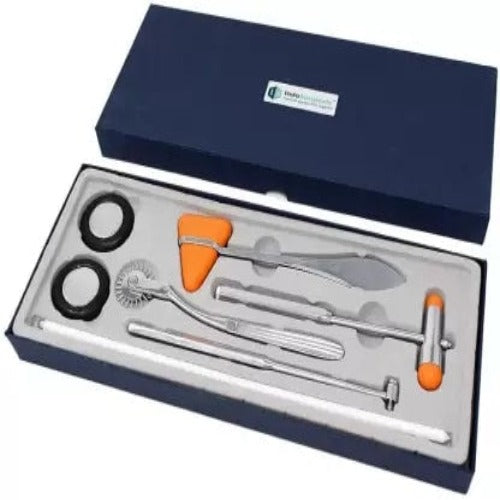
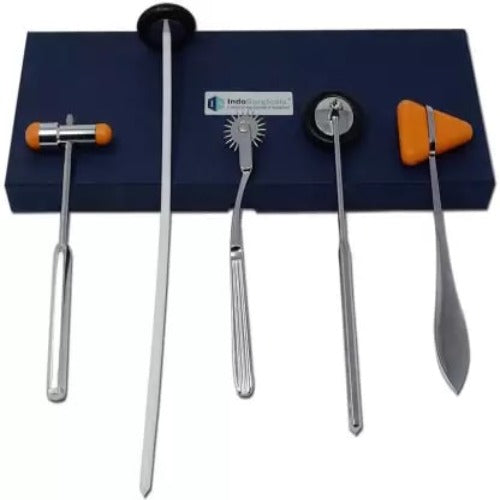
Type: General Accessories
Neurological Knee Hammer Set
Collection:
Reflex Hammers: Assess Nervous System Health
In the digital age of medicine, where MRI and CT scans dominate diagnostics, the reflex hammer remains an irreplaceable bedside tool. Also known as a tendon hammer, neurological hammer, or percussion hammer, this simple instrument provides immediate, real-time data about a patient's nervous system integrity.
Whether you are a seasoned neurologist, a physiotherapist, or a medical student, understanding the nuances of the neurological reflex hammer is essential for accurate physical assessment. This guide explores the types, techniques, and clinical significance of this iconic medical tool.
Quick Facts: The Reflex Hammer at a Glance
| Feature | Details |
|---|---|
| Primary Function | Eliciting Deep Tendon Reflexes (DTRs) to test spinal cord segments. |
| Invention | The Taylor Hammer was the first major design (1888). |
| Grading Scale | 0 to 4+ (The Wexler Scale). |
| Core Principle | The Monosynaptic Stretch Reflex Arc. |
What is a Reflex Hammer & How Does It Work?
The principle of the reflex hammer is based on the involuntary "stretch reflex." When a clinician strikes a muscle tendon briskly, it creates a momentary stretch in the muscle fibers. This stretch is detected by sensory receptors called muscle spindles, which send an electrical impulse to the spinal cord.
The spinal cord immediately sends a motor signal back to the same muscle, causing it to contract. This entire process happens without the brain's conscious intervention, making it a "pure" test of the neurological pathway.
What is the Purpose of a Reflex Test?
The diagnostic goal of using a neurological hammer is to categorize the patient's nervous system health into three main states:
- Normoreflexia (Normal): Indicates a healthy, intact reflex arc.
- Hyporeflexia (Diminished): Often suggests a Lower Motor Neuron (LMN) lesion, peripheral nerve damage, or hypothyroidism.
- Hyperreflexia (Exaggerated): Suggests an Upper Motor Neuron (UMN) lesion, such as a stroke, spinal cord injury, or multiple sclerosis.
The Anatomy of Choice: Types of Reflex Hammers
In the clinical world, the "best" reflex hammer is often a matter of personal preference, balance, and the specific requirements of the examination. While all tendon hammers serve the same fundamental purpose, their mechanical designs vary significantly, affecting the "swing" and the force delivered to the tendon.
Comparison: Major Reflex Hammer Designs
| Hammer Type | Design Shape | Best For | Key Advantage |
|---|---|---|---|
| Taylor (Tomahawk) | Triangular Rubber Head | General Practice / Students | Compact & lightweight for pockets. |
| Babinski | Circular Disc on Metal Rod | Neurology Specialists | Excellent gravity-fed swing. |
| Queen Square | Large Round Plastic/Rubber | Comprehensive Neuro-Exams | Flexible handle reduces patient discomfort. |
| Tromner | Dual-Headed Mallet | Specialized Reflex Testing | Different weights for large/small tendons. |
| Buck | Dual Head with Chrome Body | Multi-Sensory Testing | Includes built-in brush and needle. |
Babinski vs. Taylor Hammer: What is the Difference?
One of the most frequent questions from medical students is: "Which reflex hammer is best for neurological exams?" The answer usually lies in the comparison between the Taylor and Babinski models.
- The Taylor Hammer: Developed in 1888, this is the most common neurological hammer seen in clinics. It is iconic for its tomahawk shape. It requires the clinician to provide the arc of the swing manually.
- The Babinski Hammer: This features a weighted circular head and a often-telescopic metal handle. The principle of the reflex hammer in this design is gravity—the weight of the head does the work. Additionally, the pointed end of the Babinski handle is specifically designed to elicit the Babinski Sign (plantar reflex) on the sole of the foot.
Primary Uses of a Reflex Hammer
While its primary role is testing DTRs, a high-quality percussion hammer has several secondary uses in a clinical setting:
- Myotatic Reflex Testing: Testing the knee (L3-L4), ankle (S1-S2), biceps (C5-C6), and triceps (C7-C8).
- Chest Percussion: Used by some physicians to tap the chest or abdomen to listen for resonance or dullness, helping to detect fluid or air.
- Sensory Testing: Hammers like the Buck Hammer contain a removable brush and pin to test for light touch and sharp/dull pain perception.
Mastering the Flick: How to Use a Reflex Hammer Properly
Eliciting a reflex is an art form that requires a balance of speed and precision. Many beginners make the mistake of using too much arm force; however, the principle of the reflex hammer relies on a quick "flick" of the wrist to create a rapid stretch. Follow this detailed clinical protocol:
Step-by-Step Clinical Technique:
- Patient Positioning: The muscle being tested must be in a neutral, relaxed position. For the patellar reflex, the legs should hang freely over the edge of the examination table.
- Palpate the Tendon: Use your non-dominant thumb to locate the soft "dip" of the tendon. Striking bone is painful and non-diagnostic.
- The Grip: Hold the tendon hammer loosely at the very end of the handle. A tight grip dampens the vibration and reduces the "snap" of the strike.
- The Strike: Swing the hammer in a brisk arc, allowing the weight of the head to do the work. The head should bounce off the tendon immediately—do not leave it pressed against the skin.
- The Jendrassik Maneuver: If a reflex is difficult to elicit, ask the patient to hook their fingers together and pull. This "distraction" primes the spinal cord and often brings out a hidden reflex.
Interpretation: The 0 to 4+ Grading Scale
Once you elicit a response with your neurological hammer, you must grade it according to the standardized Wexler Scale. Consistency in grading is vital for tracking a patient's progress over time.
| Grade | Description | Clinical Meaning |
|---|---|---|
| 0 | No Response | Abnormal (Areflexia) |
| 1+ | Diminished / Sluggish | Low Normal or Hyporeflexia |
| 2+ | Average / Brisk | Normal |
| 3+ | Very Brisk | High Normal (Potentially Pathological) |
| 4+ | Hyperactive with Clonus | Abnormal (Hyperreflexia) |
Key Features to Look for in a Reflex Hammer
In 2026, a "cheap" hammer can lead to diagnostic errors. When purchasing your percussion hammer, evaluate these three essential features:
- Head Material: Look for medical-grade silicone or dense synthetic rubber. Natural latex can cause allergies, and poor-quality rubber can harden over time, becoming painful for the patient.
- Handle Balance: The weight should be heavily biased toward the head. A balanced reflex hammer allows gravity to do 80% of the work, ensuring a consistent strike force every time.
- Integrated Tools: Advanced models (like the Tromner or Buck) often include a built-in brush for light-touch testing and a neurological pin for sharp/dull discrimination. This "3-in-1" utility is a favorite among medical students.
⚠️ Clinical Warnings & Safety
- Avoid Bony Prominences: Striking the patella (kneecap) or malleolus (ankle bone) can cause acute pain and hematomas. Always palpate the soft tendon before striking.
- Symmetry Check: Never interpret a reflex in isolation. Always compare the left limb to the right limb. Asymmetry is a much stronger indicator of pathology than a globally low or high reflex.
- Infection Control: If using a hammer with a built-in needle or brush, ensure these are sanitized between patients or use single-use neurological pins to prevent cross-contamination.
Who Uses Reflex Hammers? A Multidisciplinary Essential
While often associated with neurologists, the reflex hammer is a fundamental tool across various medical disciplines. In 2026, its utility has expanded as physical diagnostics become more integrated into routine care.
- Neurologists: The primary users, utilizing advanced sleep study equipment and hammers to map out complex central nervous system disorders.
- General Practitioners (GPs): Use the Taylor hammer for routine physicals to screen for early signs of nerve compression or systemic issues like thyroid dysfunction.
- Physiotherapists: Rely on tendon hammers to assess muscle tone and neural tension before designing rehabilitation programs.
- Medical Students: One of the first diagnostic tools a student must master. A reliable percussion hammer is a staple in every clinical kit.
- Orthopedic Surgeons: Use reflex testing to verify the success of spinal surgeries and nerve decompression procedures.
Reflex Hammer Price List in India (Estimated 2026)
In India, the reflex hammer price varies based on material quality, brand recognition, and integrated features. At MeddeyGo, we ensure that every neurological hammer meets clinical standards for weight and balance.
| Product Category | Standard Material | Estimated Price (INR) |
|---|---|---|
| Economy Taylor Hammer | PVC + Chrome Handle | ₹150 — ₹450 |
| Professional Babinski Hammer | Brass + Telescopic Steel | ₹850 — ₹1,800 |
| Queen Square (Long Handle) | Nylon + Weighted Rubber | ₹1,200 — ₹2,500 |
| Premium Tromner Hammer | Stainless Steel / Silicone | ₹2,000 — ₹4,500 |
| Complete Neurological Kit | Multi-Tool Sets | ₹3,000 — ₹6,500 |
Why Buy Reflex Hammers Online from MeddeyGo.com?
Purchasing clinical tools online requires trust in both the product's authenticity and the vendor's reliability. MeddeyGo has become the preferred choice for Indian practitioners because:
- Quality Assurance: Every reflex hammer is checked for "head-heavy" balance, ensuring it functions according to the principle of the reflex hammer.
- Specialized Selection: From the Babinski vs Taylor hammer debate to specialized Queen Square models, we stock the widest variety in India.
- Clinician-Centric: We understand the needs of medical students and busy practitioners, offering fast PAN-India shipping to even the most remote clinics.
Frequently Asked Questions (FAQs)
To conclude our guide, we address the most common technical and clinical questions regarding neurological reflex hammers in 2026.
For specialized neurological exams, the Tromner or Queen Square hammers are generally considered the best. Their weighted heads provide a consistent, gravity-fed strike that is more reliable for detecting subtle changes in reflexes compared to the lighter Taylor hammer.
The Taylor hammer has a triangular rubber head and a short handle, requiring a manual swing. The Babinski hammer features a circular, weighted head on a longer (often telescopic) metal rod. The Babinski design allows for a more controlled "flick" and includes a pointed handle tip specifically for testing the plantar reflex (Babinski sign).
Absolutely. In fact, a tendon hammer is a required tool for medical students during their clinical years. Most students start with a Taylor hammer due to its portability, but many upgrade to a Babinski or Tromner model as they begin their neurology rotations.
Yes. These terms are interchangeable. Other names include percussion hammer or simply a "reflex hammer." All these terms refer to the same category of diagnostic tools used to test the stretch reflex arc.
Consider your workflow. If you need a tool that fits in a lab coat pocket, choose a Taylor or a telescopic Babinski. If you perform many neuro-exams daily, invest in a weighted Tromner for better ergonomics and more consistent results. Ensure the head material is high-quality silicone to avoid patient discomfort.
Beyond "tendon hammer" and "neurological hammer," it is sometimes historically referred to as a Plesser or Plexor, though these terms are now rare in modern 2026 clinical practice.
Elevate Your Diagnostic Precision
The reflex hammer is more than just a tool; it is an extension of the clinician's diagnostic skill. By selecting a high-quality neurological hammer that fits your technique, you ensure that every reflex test provides the accurate diagnosis your patients rely on.
Explore the full 2026 range of professional hammers at MeddeyGo—where we combine clinical standards with the best reflex hammer prices in India.