


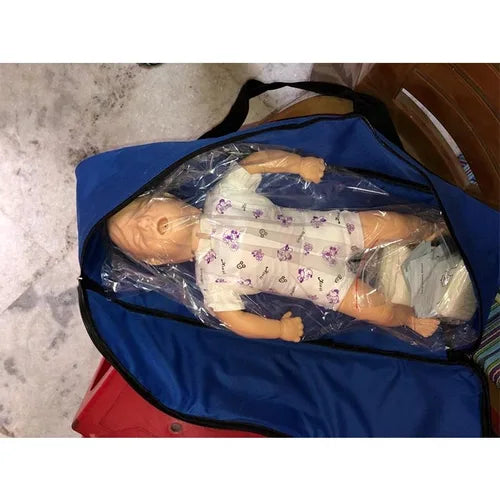


Infant CPR Simulator for Choking and Airway Training
Infant CPR Simulator for Choking and Airway Training
In stock
- Free shipping over ₹500
Couldn't load pickup availability
Share this product
Baby Airway Obstruction Infant CPR Simulator
The Baby Airway Obstruction Infant CPR Simulator is designed for CPR instructors, medical colleges, nursing institutes, hospitals, emergency training centres and first-aid programmes. This infant CPR simulator helps learners practise the correct response to foreign-body airway obstruction in an infant. Therefore, students can learn key emergency steps in a safe setting before facing a real choking emergency.
The simulator represents the body size and airway structure of an infant. In addition, its realistic form helps learners understand the correct hand position for back blows and chest thrusts. As a result, trainers can explain each step clearly and allow students to repeat the process under guidance. The model is especially useful for teaching how to respond when an infant cannot breathe because of a blocked airway.
This training model supports practical lessons for infant choking care. First, learners can practise holding the infant securely. Next, they can perform back blows in the correct area. They can then practise chest thrusts while keeping the head and body supported. Moreover, the trainer can help instructors show how to check whether the blockage has cleared after each set of actions.
The simulator is built for repeated use during CPR classes and skill sessions. Therefore, it is suitable for regular training in hospitals, colleges, ambulance services and community programmes. Its surface is also easy to clean after use. However, all practice should take place under the supervision of a qualified trainer and according to the CPR protocol followed by the institution.
Key Features
- Realistic Infant Anatomy: Infant-sized body supports practical airway and choking-response training.
- Airway Obstruction Training: Helps learners understand how a foreign object may block an infant airway.
- Back Blow Practice: Allows guided practice of correct back-blow placement and technique.
- Chest Thrust Training: Supports repeated chest-thrust practice for infant choking response.
- Safe Holding Practice: Helps learners position and support the infant correctly during care.
- Emergency Skill Development: Builds confidence for responding to infant airway emergencies.
- Repeated Training Use: Durable design supports regular CPR and first-aid training sessions.
- Easy to Clean: The surface can be cleaned and disinfected after supervised use.
- Portable Design: Easy to carry between classrooms, workshops and training centres.
Technical Specifications
| Specification | Details |
|---|---|
| Product Type | Baby Airway Obstruction and Infant CPR Training Simulator |
| Primary Use | Infant choking and airway obstruction response training |
| Age Representation | Approximate anatomy and proportions of a 9-month-old infant |
| Training Techniques | Back blows, chest thrusts and safe infant positioning |
| Airway Feature | Simulated infant airway for foreign-body obstruction training |
| Construction | Durable training-grade material |
| Cleaning | Easy to clean and disinfect after training |
| Reusable Design | Suitable for repeated supervised practice sessions |
| Portability | Lightweight and easy to transport |
| Suitable For | Medical colleges, nursing schools, hospitals, CPR classes and emergency training centres |
Benefits
- Helps learners understand infant choking response step by step.
- Improves correct hand placement during back blows and chest thrusts.
- Supports safe infant holding and body-position training.
- Allows repeated practice before real emergency exposure.
- Builds confidence among students and first responders.
- Supports CPR certification and refresher training.
- Helps trainers assess technique during practical sessions.
- Easy cleaning supports regular use by several learners.
Applications
- Infant choking response training
- Foreign-body airway obstruction practice
- Back-blow technique teaching
- Chest-thrust training
- Infant positioning practice
- CPR certification courses
- Nursing and medical skill sessions
- First-responder and ambulance training
Why Choose This Infant CPR Simulator?
This infant CPR simulator provides a practical way to teach infant airway obstruction care. Therefore, instructors can explain correct holding, back blows and chest thrusts using one training model. In addition, learners can repeat each action until they develop better control and confidence. As a result, the simulator supports both beginner lessons and CPR refresher programmes.
The realistic infant size also improves hand-position training. Moreover, the reusable design makes it suitable for colleges, hospitals and professional CPR centres. Since the model is portable and easy to clean, trainers can use it during classroom sessions, workshops and community first-aid programmes.
Why Choose MeddeyGo?
- Trusted supplier of medical teaching and emergency training products
- Quality-focused solutions for practical healthcare education
- Suitable products for colleges, hospitals and CPR training centres
- Pan-India support for institutional medical equipment needs
- Reliable assistance for bulk and professional purchases
Frequently Asked Questions
1. What is this infant CPR simulator used for?
It is used for infant choking response, back-blow, chest-thrust and airway obstruction training.
2. Does it support foreign-body airway obstruction practice?
Yes. The simulator is designed to help learners practise care for a blocked infant airway.
3. Can learners practise back blows on this model?
Yes. Trainers can teach the correct position and technique for infant back blows.
4. Does it support chest-thrust training?
Yes. Learners can practise chest thrusts under the guidance of a qualified instructor.
5. What infant age does the model represent?
The model follows the approximate body proportions of a 9-month-old infant.
6. Is the simulator reusable?
Yes. It is designed for repeated CPR and first-aid training sessions.
7. Can the model be cleaned after use?
Yes. The surface can be cleaned and disinfected after each training session.
8. Where can this infant CPR simulator be used?
It can be used in medical colleges, nursing schools, hospitals, CPR courses and emergency training centres.
