Intubation Manikin for Oral and Nasal Airway Training
Intubation Manikin for Oral and Nasal Airway Training
In stock
- Free shipping over ₹500
Couldn't load pickup availability
Share this product
Airway Intubation Model
The Airway Intubation Model is designed for medical colleges, nursing institutes, hospitals, emergency training centres, anaesthesia departments and clinical skill labs. This intubation manikin helps learners practise oral and nasal airway intubation in a safe and controlled setting. Therefore, students can improve tube placement, laryngoscope handling and airway-view skills before taking part in real clinical procedures.
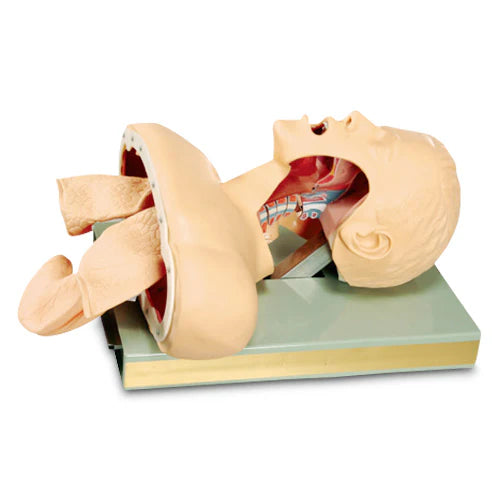
The model includes clear anatomical structures that guide learners during airway training. In addition, the head and upper-body design helps users understand the position of the mouth, nasal passage, tongue, throat, larynx and trachea. As a result, instructors can explain the full intubation route in a simple and practical way. The side-opening design also allows direct observation of tube movement during the procedure.
This training model supports both oral and nasal intubation practice. First, learners can position the head and prepare the airway. Next, they can insert the laryngoscope and identify the correct passage. They can then guide the tube towards the trachea while observing the path from the side. Therefore, the model helps improve hand control, tube direction and understanding of airway anatomy.
The trainer also includes warning feedback for common errors. For example, a warning may appear if the tube enters the stomach or if the laryngoscope puts too much pressure on the teeth. As a result, learners receive immediate feedback and can correct their technique. The model is suitable for repeated training sessions under the guidance of a qualified instructor.
Key Features
- Accurate Airway Anatomy: Clear internal structures support practical airway and intubation training.
- Oral Intubation Practice: Allows guided practice of tube insertion through the mouth.
- Nasal Intubation Practice: Supports training for tube placement through the nasal passage.
- Side View Observation: Open side section helps learners observe tube direction and final position.
- Tube Placement Training: Helps students understand the correct route from the upper airway to the trachea.
- Stomach Inflation Warning: Provides feedback when the tube enters the wrong passage.
- Dental Pressure Warning: Alerts users when the laryngoscope presses too heavily on the teeth.
- Laryngoscope Handling: Supports repeated practice of blade placement and airway opening.
- Hands-On Skill Learning: Useful for classroom teaching, skill assessment and simulation sessions.
- Reusable Training Design: Suitable for repeated supervised practice in professional training centres.
Technical Specifications
| Specification | Details |
|---|---|
| Product Type | Airway Intubation Training Model |
| Primary Use | Airway management and intubation skill training |
| Training Methods | Oral and nasal cavity intubation practice |
| Anatomical Display | Head, upper airway, throat, larynx and tracheal pathway |
| Observation Feature | Side-view access for observing tube and suction position |
| Error Feedback | Warning for stomach inflation and excess dental pressure |
| Laryngoscope Training | Supports blade handling and airway-opening practice |
| Tube Placement | Supports correct tracheal tube-position training |
| Reusable Design | Suitable for repeated supervised skill sessions |
| Suitable For | Medical colleges, nursing institutes, hospitals, anaesthesia departments and simulation labs |
Benefits
- Helps learners understand oral and nasal intubation step by step.
- Improves laryngoscope handling and tube-direction control.
- Supports practice before real patient exposure.
- Allows instructors to observe tube movement from the side.
- Provides quick feedback when common errors occur.
- Helps reduce wrong tube placement during training.
- Supports repeated use in classrooms and clinical skill labs.
- Builds confidence in basic airway management procedures.
Applications
- Oral airway intubation training
- Nasal airway intubation practice
- Laryngoscope handling lessons
- Tracheal tube placement teaching
- Airway anatomy demonstration
- Suction-position observation
- Anaesthesia skill training
- Emergency airway management practice
Why Choose This Intubation Manikin?
This intubation manikin combines oral intubation, nasal intubation, side-view observation and error feedback in one training model. Therefore, instructors can explain the full airway procedure in a clear order. In addition, learners can observe how the tube moves through the airway. As a result, they can improve placement accuracy and understand the difference between correct and incorrect insertion.
The warning system also supports better learning. Moreover, feedback for stomach inflation and dental pressure helps students correct common mistakes early. Since the model supports repeated practice, it is useful for beginners, nursing students, medical trainees, anaesthesia teams and emergency-care learners.
Why Choose MeddeyGo?
- Trusted supplier of medical teaching and airway training products
- Quality-focused solutions for practical healthcare education
- Suitable products for colleges, hospitals and clinical skill centres
- Pan-India support for institutional medical equipment requirements
- Reliable assistance for bulk and professional purchases
Frequently Asked Questions
1. What is this intubation manikin used for?
It is used for oral intubation, nasal intubation, laryngoscope handling and airway-management training.
2. Can learners practise oral intubation?
Yes. The model supports guided tube placement through the mouth.
3. Does it support nasal intubation training?
Yes. Learners can also practise tube insertion through the nasal passage.
4. Can instructors see the tube position?
Yes. The side-view design helps instructors observe tube movement and placement.
5. Does the model warn about wrong tube placement?
Yes. It can provide a warning when stomach inflation occurs due to incorrect placement.
6. Does it detect excess pressure on the teeth?
Yes. The model can alert learners when the laryngoscope puts too much pressure on the teeth.
7. Is it suitable for repeated training?
Yes. The trainer is designed for repeated supervised practice sessions.
8. Where can this airway model be used?
It can be used in medical colleges, nursing institutes, hospitals, anaesthesia departments and simulation labs.