


Type: Medansh
Viaggi Memory Foam Cervical Pillow


Type: Cervical Pillow
Cervical Memory Foam Pillow 23x13x3.5 Inch for Neck Support

Type: Medansh
Vibrating U Shape Massage Pillow for Office Home Car Travel Pillow
Collection:
Cervical Pillow
Do you ever wake up feeling more tired than when you went to bed, with a stiff, aching neck? You fluff, fold, and fight with your pillow all night, but it never seems to provide lasting comfort. That familiar battle is often a sign that the problem isn't how you’re sleeping, but what you’re sleeping on.
This frustration is what leads to the "pillow graveyard"—a closet full of pillows that promised a great night's sleep but only delivered more morning stiffness. The issue isn't about finding a fluffier or firmer rectangle. For many, the real culprit is that a traditional pillow is designed for one job—cushioning your head—when your neck is desperately asking for another: support.
Enter the cervical pillow. Its unusual contours and curves aren't for show; they have a specific purpose. As physical therapists often explain, a healthy sleep posture requires your head, neck, and spine to stay in a straight line. A cervical pillow is a tool built to fill the gap beneath your neck, providing the structural support needed for true neck pain relief while sleeping—something a standard pillow simply can't do.
But with so many strange shapes and materials, choosing the right pillow can feel overwhelming. This guide will break it all down. We’ll walk through a simple process to find the perfect match for your body and sleep style, turning what felt like a random problem into a clear path toward waking up refreshed and pain-free.
What Is a Cervical Pillow—And How Is It Different From Your Flat Pillow?
If you’ve ever found yourself bunching, folding, or fighting with your pillow, you’ve felt the core problem with traditional designs: they only cushion your head. A cervical pillow, however, has a completely different job. Its primary goal is to support the natural curve of your neck, filling the gap between your head and shoulders. Instead of just being a soft rectangle, it’s a tool specifically shaped to work with your body’s anatomy.
Think of your head as being as heavy as a bowling ball. When a flat pillow leaves your neck unsupported, your muscles have to work all night to hold that weight up. This constant, low-grade tension is a major reason for waking up with stiffness and soreness. The main orthopedic benefits of a cervical pillow come from taking that stressful job away from your muscles, allowing them to finally relax and recover as you sleep.
That’s why the unique dips and raised edges you see on a contour pillow aren’t just for looks; they are engineered to provide that missing support. The debate of a contour pillow vs a traditional pillow comes down to this: one is passive, while the other is active. By properly cradling your neck, a cervical pillow helps guide your spine into a more natural and restful position.
The "Neutral Spine" Secret: Why Your Neck Muscles Aren't Resting at Night
You know that feeling of relief when you stand up straight, aligning your shoulders over your hips? That comfortable, straight line is what experts call a "neutral spine," and it’s the position where your muscles are most relaxed. The goal of a good pillow is to maintain this exact alignment while you’re lying down. However, a pillow that’s too high or too flat forces your neck into an unnatural bend for hours on end, destroying any hope of achieving proper head alignment during sleep.
When your neck is bent, your muscles can’t fully shut down for the night. Instead of resting and repairing, they enter a state of constant, low-grade tension, trying to support your head in that awkward position. This is the core cause of nightly muscle strain—the reason you can get eight hours of sleep and still wake up feeling like your neck ran a marathon. Your muscles are exhausted because they’ve been working overtime instead of recovering.
Achieving a neutral spine is the key to finally giving those overworked muscles a break, which is the secret to real neck pain relief while sleeping. This is where choosing the right pillow for spinal alignment becomes so important. A cervical pillow is designed to fill the unique gap between your head and the mattress, but that gap changes dramatically depending on how you sleep. Before you can find the right pillow, you first have to answer one simple question.
The First Step to Relief: Answering "What's Your Sleep Position?"
Your sleep position is the single most important piece of the puzzle when it comes to maintaining that neutral spine we just discussed. Why? Because the empty space between your head and the mattress—the very gap your pillow needs to fill—changes dramatically whether you’re on your back or your side. Finding the best pillow for neck and shoulder pain isn't about a one-size-fits-all solution; it's about matching the pillow's shape and height to the way you sleep most often.
Think about lying on your side. There’s a significant gap between your ear and the mattress, roughly the width of your shoulder. If a pillow is too soft or low, your head will droop downwards, creating a painful bend in your neck. This is why an ergonomic pillow for side sleepers is typically higher and firmer; its purpose is to bridge that wide gap perfectly, keeping your head level with your spine and taking pressure off your shoulder.
Now, picture yourself on your back. The gap is much smaller. Here, the goal is to support the natural curve of your neck without pushing your head too far forward. A pillow that’s too high for a back sleeper will force your chin toward your chest, straining the muscles at the back of your neck. This is where a complete pillow loft and firmness guide becomes essential, as back sleepers need a much lower and more contoured profile than side sleepers.
So, how do you know your dominant position? Pay attention to two key moments: the position you naturally settle into when you’re trying to fall asleep, and the one you’re in when you first wake up. Most people have a clear preference. Once you’ve identified whether you're primarily a back or side sleeper, you can finally start looking for a pillow that is built specifically for you.
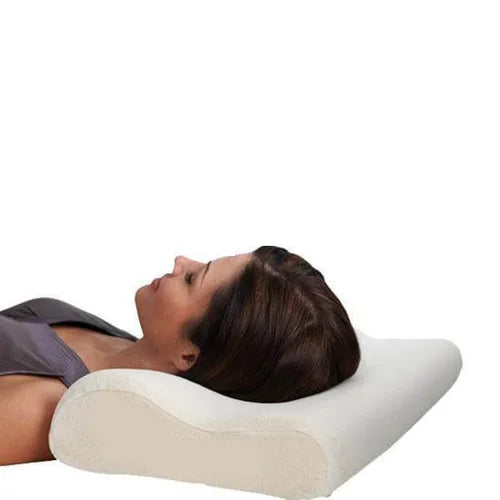
The Side Sleeper's Guide: How to Find a Pillow That Fits Your Frame
If you’re a side sleeper, your main challenge is the space created by your shoulder. To keep your spine straight, you need an ergonomic pillow for side sleepers that is both higher and firmer than average. The goal is simple: bridge the gap from your ear to the mattress to prevent your head from drooping. The right pillow height, or "loft," for you depends entirely on your body frame—someone with broad shoulders will naturally need a thicker pillow than someone with a smaller build to achieve that perfect alignment.
This is where the unique shape of a contour pillow becomes so helpful, but it's also where most people get confused. Which side goes under your neck? For side sleepers, the answer is clear: the taller of the two curves should be tucked under your neck. This intentional design provides a supportive ramp that cradles your neck while lifting your head to be level with your spine. Using the shorter side will likely feel no different from a flat, unsupportive pillow, defeating the purpose and leading to pillows for alleviating morning stiffness that just don't work.
To find the right fit, use this simple checklist when shopping:
- Choose a firmer material: Look for dense memory foam or latex that won’t collapse under the weight of your head overnight.
- Look for a higher loft: Your pillow should be thick enough to match your shoulder width.
- Use the taller curve: When using a contour pillow vs traditional pillow, always place the higher wave under your neck for proper side-sleeping support.
With the right pillow, you’re not just cushioning your head—you’re providing the structural support your neck needs all night long. But what if you sleep on your back? That requires a completely different approach.
The Back Sleeper's Blueprint: Supporting Your Neck's Natural Curve
For back sleepers, the game changes entirely. Instead of needing a high, firm pillow to fill the space from your shoulder, your primary goal is to support the natural curve of your neck. Lying on your back creates only a small gap between your neck and the mattress. A pillow that's too high will push your head forward, tucking your chin toward your chest and straining the very muscles you're trying to relax. The ideal pillow is therefore lower, with a special focus on cradling your neck.
This is where the other side of a contour pillow comes into play. To learn how to use a contour pillow properly as a back sleeper, you should place the lower of the two curves under your neck. This smaller, rounded bump acts as a "neck roll," filling that slight gap perfectly without forcing your head up at an awkward angle. It provides just enough support to maintain proper head alignment during sleep, preventing your head from tilting back or being pushed too far forward.
But what if you don't stay in one position? Many people are combination sleepers, shifting from their back to their side throughout the night. If this sounds like you, a well-designed contour pillow is an excellent solution. The dual-height design is intentional, giving you a higher loft for when you're on your side and a lower, supportive roll for when you're on your back. It’s no surprise that these are often chiropractor recommended pillows, as their versatility helps maintain a healthy posture no matter how you move.
By choosing a pillow that accommodates both positions, you give yourself the freedom to shift comfortably without sacrificing support. This thoughtful design helps ensure your spine remains in that neutral, straight line all night long. Of course, there's one position we haven't covered, and it presents the biggest challenge of all for neck health: stomach sleeping.
A Frank Talk for Stomach Sleepers: How to Minimize Neck Strain
For those who sleep on their stomachs, we need to be direct: this position is the toughest on your neck. To breathe, you must twist your head to one side, holding it in that rotated position for hours. This completely breaks the neutral alignment we’ve been discussing, forcing your neck muscles and joints into a prolonged, unnatural strain. Waking up with a stiff neck or a nagging ache isn't surprising—it's your body telling you it was under stress all night, which is a major barrier to neck pain relief while sleeping.
Because of this inherent twist, choosing the right pillow becomes a game of damage control. A thick, fluffy pillow is your neck’s worst enemy here, as it would crank your head back at an even more severe angle. The best-case scenario for a dedicated stomach sleeper is an extremely thin pillow—one that’s almost flat—or even no pillow at all under your head. This keeps your neck as level with the rest of your spine as possible, minimizing the severity of that twist and reducing the chances of waking up with pillows for morning stiffness being your first search of the day.
If you’re open to changing your habits, many have found success transitioning to their side by hugging a body pillow. This provides the comforting pressure on your front that many stomach sleepers crave, while physically encouraging you to stay on your side. Whether you’re trying a new position or sticking with a thin pillow, the next step is understanding what it's made of. The material itself—from foam to latex—dramatically changes how that support feels.
Decoding Materials: How Memory Foam, Water, and Latex Feel and Function
Beyond the shape, the material inside your pillow determines the feel of the support you receive. Choosing the right one is less about which is "best" and more about what your body prefers. The three most common options in cervical pillows each offer a distinct experience for achieving that comfortable, aligned sleep.
Memory foam is perhaps the most well-known, famous for its slow-sinking, deep-cradling sensation. It molds precisely to your head and neck, offering excellent pressure relief. Think of it like pressing your hand into firm, wet sand—it holds the shape perfectly. The main drawback is that traditional memory foam can trap heat. To combat this, look for versions infused with gel or copper, which are popular materials for cooling neck pillows. In contrast, natural latex is bouncy and responsive. Instead of sinking in, it provides an instant, springy lift that supports you without the deep contouring. It also happens to be one of the most breathable and naturally cool materials available.
For those who struggle to find the perfect height and firmness, a water pillow offers a unique solution. These pillows feature a water-filled base that you can adjust by simply adding or removing water, giving you complete control. This makes the debate of memory foam vs water pillow for neck support a matter of preference: do you want a material that molds to you, or one you can customize for yourself?
Here’s a quick guide to help you choose:
- Memory Foam: Best for deep contouring and pressure relief. Can sleep hot unless infused with cooling gel.
- Latex: Best for responsive, bouncy support and natural cooling. Great for those who dislike a "sinking" feeling.
- Water: Best for customizable firmness and height. Responds instantly as you shift positions.
Ultimately, the orthopedic pillow benefits come from matching the right material and shape to your body. Now that you know what to look for, the final step is learning how to use your new pillow correctly to get the most relief.
How to Use a Contour Pillow Correctly (And Avoid Making Neck Pain Worse)
That wavy shape on your new pillow isn't just for looks—it's a roadmap for your neck. The biggest mistake people make is using it like a traditional pillow. The key to learning how to use a contour pillow properly is understanding that the two different curves serve two different purposes, depending on how you sleep. One side has a higher, thicker curve, while the other is lower and gentler. Choosing the wrong one can actually create strain instead of relieving it.
For back sleepers, the goal is to support the natural C-shaped curve of your neck. To do this, orient the pillow so the smaller curve is tucked into the space between your neck and the mattress. Your head should then rest comfortably in the indented area in the middle. If you're a side sleeper, you need to fill the much larger gap between your ear and your shoulder. For this, you’ll use the higher, thicker curve. This keeps your head from drooping and ensures your spine stays in a straight line from your neck all the way down.
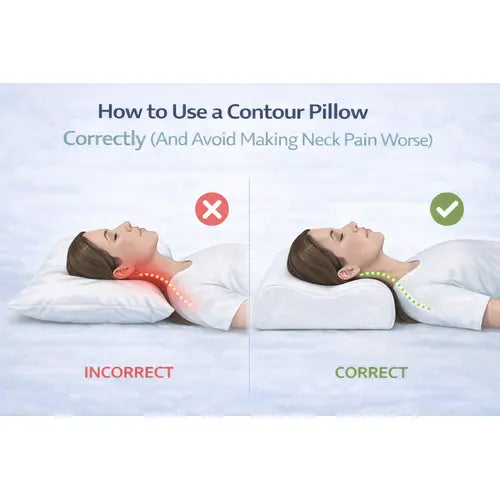
Unlike the contour pillow vs traditional pillow you might fluff or fold, a contour pillow is meant to hold a specific shape to do its job. Because it's actively repositioning your neck for better alignment, it’s not always comfortable on the very first night. This new feeling is completely normal. In fact, fully adjusting to a new therapeutic pillow is a process that can take a few days to a week.
That "Weird" Feeling: How to Adjust to Your New Therapeutic Pillow
That initial strange or even slightly stiff feeling is a sign that your body is adapting. For years, your neck muscles may have been compensating for a lack of support from a traditional pillow. Now, they are being asked to relax into a new, healthier alignment. This process of adjusting to a new therapeutic pillow is completely normal and can last anywhere from a few nights to two weeks as your body unlearns old habits and settles into a better posture.
To make the transition smoother, don't feel like you have to commit to a full eight hours on the first night. Instead, try using your new pillow for just an hour or two when you first go to bed. If you start to feel any discomfort, simply swap it out for your old pillow. Each night, gradually increase the time you spend on the new pillow. This gentle approach gives your muscles time to adapt without causing unnecessary strain, making it much easier to stick with the change.
Think of it like starting a new exercise at the gym—your muscles might feel a little sore at first because they’re being used in a new, correct way. This initial awkwardness often means the pillow is doing its job by gently correcting an alignment that may have been causing pain. But is this adjustment period worth it in the long run? And do neck support pillows really work for lasting relief?
Do Neck Support Pillows Really Work? A Look at the Evidence and Expert Opinions
It’s a fair question: with so many products promising relief, do neck support pillows really work? The short answer is yes, but not through magic. The real benefit comes from seeing the pillow not as a simple cushion, but as a postural tool for the night. Just as sitting in a supportive office chair helps prevent back strain during the day, a cervical pillow is designed to maintain your neck’s natural curve while you sleep. By filling the gap between your head and shoulders, it prevents your neck muscles from working overtime, allowing them to fully relax and recover.
This principle is why you’ll often hear about chiropractor recommended pillows. Health professionals like physical therapists and chiropractors focus on restoring proper alignment to the body, and they frequently suggest cervical pillows to help you maintain that healthy posture for the eight hours you’re in bed. It’s not just a product; it’s a tool that supports the work they do, helping to prevent you from undoing a day's progress with a night of poor alignment. For them, it’s about giving you the right support to let your body heal itself.
Beyond expert recommendations, research backs up the orthopedic pillow benefits. Studies have consistently found that a pillow chosen for proper height and shape can lead to a measurable decrease in chronic neck pain and a significant improvement in sleep quality compared to a standard pillow. The key takeaway from all this evidence is that a pillow’s effectiveness isn't about a specific brand or material, but how well it supports your unique anatomy. The real secret, therefore, lies in matching the pillow to the person.
Your 3-Step Plan to Finally Choosing the Right Cervical Pillow
You started this journey knowing one thing for sure: your neck hurts and your current pillow isn’t helping. But you’ve now moved beyond the problem and into the solution. You understand that proper sleep posture isn't a luxury—it's the key to waking up refreshed. You’re no longer guessing what might work; you have the knowledge to find a pillow that provides the exact support your body needs.
This simple checklist is your roadmap. Use this pillow loft and firmness guide to find the best pillow for neck and shoulder pain, tailored specifically to you.
Your 3-Step Checklist:
- Identify Your Position: Determine if you are primarily a side, back, or combination sleeper. This is your starting point.
- Match Loft to Your Body: Choose a higher loft for side sleeping to fill the gap between your ear and shoulder. For back sleeping, pick a lower loft with a neck roll to support your spine's natural curve.
- Pick Your Feel: Choose your material based on preference: Memory Foam for a cradling sensation, Latex for responsive support, or Water for customizable firmness.
You're no longer guessing. You now have the knowledge to leave the 'pillow graveyard' behind and invest in a tool for truly restorative sleep. Waking up refreshed isn't about luck; it's about having the right support, and now you know exactly how to choose the right cervical pillow to find it.