
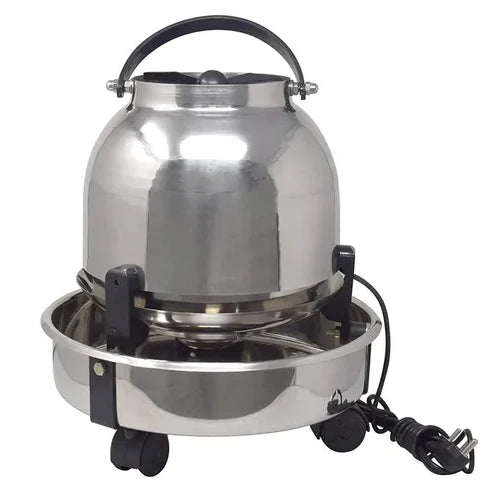
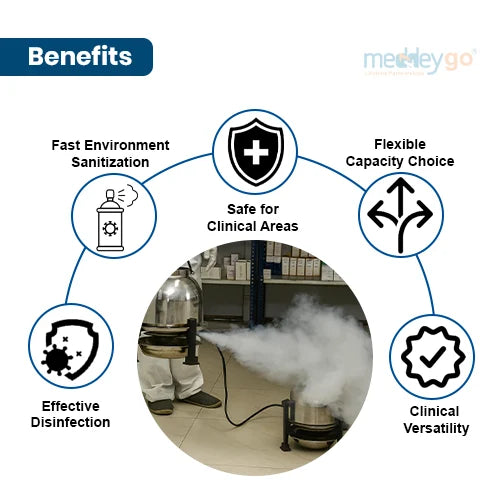
Type: General Accessories
Portable Fumigation Machine Fumigator SS for OT, ICU and Laboratories
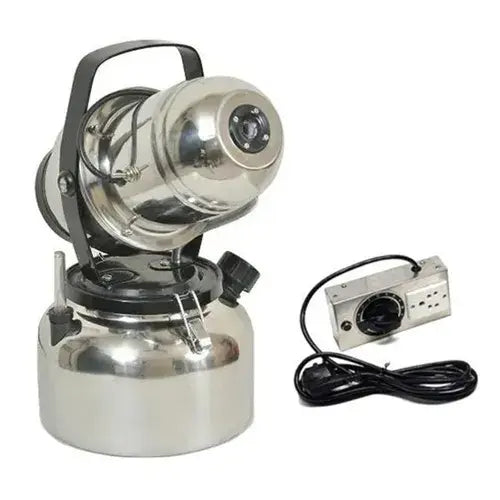
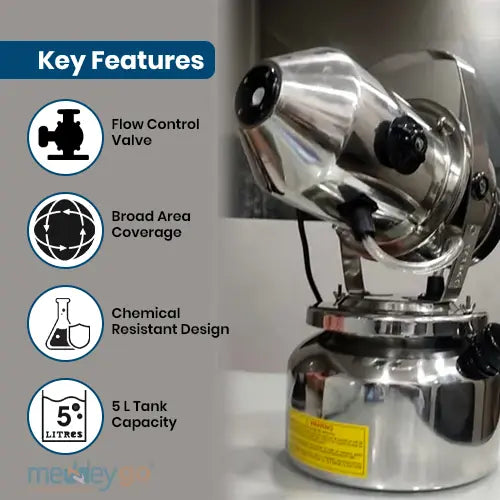
Type: Fumigators
Stainless Steel ULV Fogger Machine for Fumigation Sanitization


Type: Medansh
Fumigation Machine with Timer 5 Lt for OT Lab
Type: Fumigators
Stainless Steel ULV Fogger Machine | Fumigation


Type: Fogger
Fogger Machine with Digital Timer for Sanitization
Collection:
Benefits of Hospital Fumigation Machines Explained
We have all walked into a hospital room that smells of fresh bleach and looks spotless, assuming that visual cleanliness equals safety. However, a room that appears sparkling clean to the naked eye can still harbor invisible threats in the air or on hard-to-reach surfaces. While janitorial staff work incredibly hard, traditional cleaning methods like mopping and wiping are limited by what a person can see and physically touch.
Microscopic pathogens are experts at finding "shadow zones" where a cloth simply cannot reach. Consider the complex buttons on a television remote, the tiny crevices inside a ventilation grate, or the back of a heart monitor screwed into the wall. Studies in infection prevention suggest that manual cleaning might miss less accessible surfaces, leaving behind bacteria that can survive for days or even weeks.
Hospital Fumigation Machines bridge the gap between looking clean and being truly safe. These devices act like automated fog machines for medicine, transforming liquid disinfectants into a dry, comprehensive mist. Instead of relying on a human to scrub every square inch, the machine fills the entire space with a cleaning agent that hunts down germs in every corner.
Standard cleaning is like trying to clean every leaf in a dense forest by hand; bio-decontamination is a restorative rain washing over that same forest, touching every leaf, branch, and hidden root simultaneously. The mist generated by this infection control equipment behaves more like a gas than a spray. It drifts into the charging port of a tablet and settles behind heavy furniture without getting anything wet. The chemical used is often a highly concentrated form of hydrogen peroxide---engineered to be thousands of times more effective against resistant bacteria than standard household solutions.
Because the mist is so fine, it achieves a level of hygiene called clinical sterility. While a clean-looking room might still have thousands of active germs, a fumigated room undergoes a "log reduction," reducing the population of pathogens by 99.9999%. This ensures that for every million bacteria present, perhaps only one survives.
Hospitals utilize this technology to reset a room's biological environment completely between patients. By removing the element of human error from the cleaning process, facilities can guarantee that the air you breathe and the bed rails you touch are free from dangerous organisms. This is a critical step in reducing healthcare-associated infections through bio-decontamination, protecting patients with weak immune systems from catching something new while they recover.
Hospital fumigation machines convert concentrated hydrogen peroxide into a dry, gas-like mist that reaches shadow zones missed by manual cleaning, delivering whole-room bio-decontamination. They achieve hospital-grade log-6 reductions (99.9999%) while remaining safe for electronics, and they outperform line-of-sight UV-C in cluttered spaces, standardizing terminal cleaning with rapid room turnaround. Smart controls optimize particle size and humidity, followed by catalytic aeration and strict lockout procedures to protect staff and patients. Though an investment, these systems reduce healthcare-associated infections, cut delays, and provide reliable peace of mind.
Why Manual Wiping Only Solves Half the Problem
When we see a sparkling floor or a shiny counter, we naturally assume a room is safe. However, traditional cleaning relies heavily on a person physically touching a surface with a chemically treated cloth. This method works perfectly for flat, open spaces like tray tables, but it struggles with the complex reality of a modern patient room. If a human hand can't reach a specific spot, or if a busy staff member accidentally skips a bed rail, the germs remain active and dangerous.
Even when a cleaner is thorough, the liquid disinfectant itself has physical limits. Surface tension often prevents liquid cleaners from soaking into microscopic scratches or textures on equipment, behaving like a bead of water on a waxed car hood. While a wipe glides over the top, bacteria can survive comfortably deep inside these tiny crevices where the chemical never actually touches them.
Experts call these untouched areas "shadow zones." Just as a lamp casts shadows behind furniture, manual cleaning leaves safety shadows behind monitors, inside ventilation grates, and underneath the complex wiring of medical devices. A standard TV remote control alone might have dozens of these zones around its buttons. Because these intricate objects are touched constantly but are difficult to scrub perfectly, they often become invisible safe havens for pathogens to multiply.
To truly secure a hospital environment, we need a way to reach every single exposed surface, regardless of its shape or location. This necessity paved the way for a technology that moves differently than a liquid: the hospital fumigation machine.
What Exactly is a Hospital Fumigation Machine?
To reach those hidden shadow zones, facilities rely on technology that fills the entire space with a sanitizing atmosphere. While they may resemble industrial humidifiers, modern hospital fumigation machines are precise instruments designed to saturate the air itself. Often technically described as a medical-grade cold fogger or vapor generator, these devices function as automated delivery systems. They take the variability of human scrubbing out of the equation, ensuring that the disinfectant travels wherever the air goes.
The "muscle" inside these machines is often a much stronger version of common Hydrogen Peroxide, but engineered to work without wetting surfaces. By breaking this chemical down into microscopic particles, the device creates a "dry mist" that behaves more like a gas than a spray. This allows the sanitizer to drift deep into ventilation ducts, settle between keyboard keys, and wrap completely around bed rails without damaging sensitive electronics.
Operating this technology requires a strict "set and forget" protocol. A technician places the unit in an empty room, seals the doors, and activates the cycle from the hallway. While the specific nomenclature for what a fumigation machine is called varies by method, the result is always a calculated, automated flood of disinfectant. This precise control is necessary to manage the delicate transition from a liquid bottle to a room-filling cloud.
From Liquid to Cloud: How Bio-Decontamination Works
Standard cleaning sprays succumb to gravity; heavy droplets fall straight to the floor, leaving gaps in coverage. Fumigation machines defy this gravitational pull by using high-speed vibrations or pressure to shatter liquid disinfectant into millions of invisible particles. This transforms a heavy splash into a buoyant cloud that effectively alters the atmosphere of the room.
To overcome gravity, these droplets must be microscopically small. While a single strand of human hair is roughly 70 microns wide, the particles generated during this process are often smaller than 10 microns. Because they are so light, they enter a state of suspension, hovering in the air for extended periods rather than settling immediately. This allows the disinfectant to travel on air currents, drifting around corners and behind heavy medical equipment just like smoke.
This specific size range creates a "dry mist." Even though aerosolized hydrogen peroxide starts as a liquid, the particles are too small to burst and soak materials upon contact. The mist bounces off surfaces gently, sanitizing the outer layer without causing short circuits or making documents soggy.
By floating rather than falling, the cloud achieves true bio-decontamination throughout the entire space. The sanitizing gas expands to fill every available cubic inch, hunting down pathogens hiding in ventilation grates or the underside of a patient's bed table.
The '99.9999% Rule' and Why It Matters for Your Safety
Household cleaners often boast that they kill 99.9% of germs. While impressive for a kitchen counter, this is dangerously insufficient for a surgery suite or an isolation room. Hospitals measure the efficacy of dry mist foggers using a stricter scale called "Log Reduction." This logarithmic scale counts the number of nines in the percentage; the more nines, the safer the room. If you start with a million dangerous bacteria, leaving just 0.1% behind means thousands of pathogens remain alive to multiply.
To understand why medical facilities demand such extreme power, consider a single surface contaminated with one million invisible pathogens. Here is how many germs survive based on the cleaning standard applied:
- 99% Clean (Log 2): 10,000 survivors remain (Standard household cleaning).
- 99.99% Clean (Log 4): 100 survivors remain (Standard sanitizing).
- 99.9999% Clean (Log 6): 1 survivor remains (Hospital-grade sterilization).
Achieving that "Log 6" standard---essentially zero survivors---is the specific goal of high-level disinfection . Fumigation systems pair this automated precision with potent EPA-registered disinfectants to ensure that even the most resilient superbugs are eliminated before a new patient enters the room.
Hydrogen Peroxide Vapor vs. UV-C: Choosing the Right Shield
Lighting a cluttered bedroom with a single flashlight illustrates the primary limitation of UV light robots: they rely on "line-of-sight." You can easily brighten the walls directly in front of you, but deep shadows remain behind the bed and inside open drawers. While ultraviolet energy is powerful against germs it can physically reach, any pathogen hiding in the shadow of a heart monitor or beneath a bed rail remains safe from the light.
Unlike light beams that travel only in straight lines, a gas expands to fill every available inch of space. This physics concept is the deciding factor in the hydrogen peroxide vapor vs UV-C disinfection comparison. The vapor behaves like air, drifting around corners, seeping into ventilation grates, and settling into the tiny crevices of a remote control. It does not matter if a heavy medical cart is blocking the machine; the mist saturates the entire room atmosphere, hunting down bacteria regardless of where they hide.
Modern patient rooms are filled with complex equipment, creating thousands of potential shadows. Because of this clutter, hospitals often deploy automated whole room surface disinfection systems that utilize vapor to guarantee total coverage. While light works incredibly well for flat, empty operating theaters or quick targeted zaps, a gas-based system ensures that even the back of a television or the underside of a table is rendered sterile.
Why Your Hospital's Tech is Safe Around This Mist
The idea of filling a room with chemical fog might seem like a recipe for a technological disaster, especially given our fear of spilling liquids near laptops. However, the technology used in modern hospitals relies on a "dry mist." Unlike a standard cleaning bottle that leaves heavy droplets and puddles, these advanced machines break hydrogen peroxide into particles so microscopic that they bounce off surfaces without actually wetting them. This unique property ensures that the vapor attacks germs, not circuit boards.
Common concerns regarding whether medical grade foggers are safe for electronic equipment are answered by the physics of the vapor. Because the mist exists in a near-gas state, it does not conduct electricity or cause rust the way liquid water would. This allows the disinfectant to swirl around delicate ventilators, complex heart monitors, and nurses' workstations, sterilizing the tiny buttons and cooling vents without causing short circuits or corrosion.
Protecting these tools is critical because they serve as lifelines for the most vulnerable patients. Hospitals rely on this delicate balance of power and safety to maintain high-level disinfection for intensive care units, where moving heavy, life-saving machinery out of the room for deep cleaning simply isn't an option.

The Secret to Sterile Surgery: Dry Mist Foggers in the Theater
When a patient is wheeled into surgery, their biggest fear shouldn't be the cleanliness of the room. Yet, even after a team of cleaners scrubs the floors and walls, microscopic threats can linger in the air or on the underside of a surgical lamp. This hidden danger is the primary cause of surgical site infections (SSI), a complication that hospitals fight aggressively to prevent. To win this battle, modern facilities have moved beyond simple buckets and sponges to a rigorous process known as a "terminal clean."
Terminal cleaning hits the "factory reset" button on the entire room. While manual scrubbing removes visible dirt and fluids, it cannot guarantee that every nook is sterile. This is where the efficacy of dry mist foggers in surgical theaters becomes a game-changer. Once the physical mess is gone, the machine takes over to hunt down the invisible pathogens that human hands might miss.
The protocol follows a strict four-step rhythm to ensure total safety:
- Pre-clean: Staff manually remove all waste and wipe down surfaces to clear the path for the gas.
- Seal: Vents and doors are secured to keep the disinfectant contained strictly within the suite.
- Mist: The automated unit fills the room with a dry chemical fog that reaches every corner and crevice.
- Aerate: The system scrubs the air clean, removing the gas so the room is safe for the surgical team to re-enter.
By standardizing this process, hospitals eliminate the guesswork of manual cleaning. The procedure guarantees that the next patient enters a truly sterile environment, regardless of what happened in the room previously. These same steps for terminal cleaning in isolation wards are used to stop contagious outbreaks from spreading.
Winning the War Against Superbugs: MDROs and Mists
Antibiotics have saved countless lives, but their overuse has forced bacteria to evolve into "superbugs" capable of surviving our strongest medicines. Known medically as Multi-Drug Resistant Organisms (MDROs), these germs pose a serious threat because they often build a biological shield called a spore to stay alive. A standard disinfectant wipe might clean the surface of this shell, but the germ inside survives, waiting to infect the next patient. Hospitals must deploy specialized bio-decontamination protocols for multi-drug resistant organisms to neutralize these threats.
Chemical mist functions as the ultimate pathogen defense. Unlike liquid bleach, which pools on flat surfaces, vaporized hydrogen peroxide moves like a gas, drifting into bed rails, remote control buttons, and ventilation grates where superbugs hide. Once the mist lands on a spore, it triggers a powerful oxidation reaction---essentially rusting away the germ's protective armor in seconds. This chemical attack destroys the bacteria's internal machinery, ensuring it cannot reproduce or mutate further.
Treating a room with this level of intensity functions as a form of microscopic hospital pest control, eradicating threats that are invisible to the naked eye. This automated consistency removes human error from the equation, providing families with the peace of mind that the room is truly safe.
How Humidity Makes the Mist Even Deadlier
While one might assume drier air is better for cleaning, hydrogen peroxide mist actually needs specific moisture levels to work effectively. If the air is too dry, the disinfectant evaporates before it can finish the job; if it is too damp, the droplets become heavy and slide off surfaces. The goal is a precise phenomenon called micro-condensation, where an invisible layer of disinfectant forms on surfaces. This layer is thin enough to avoid wetting the bed sheets or damaging electronics, but substantial enough to suffocate bacteria hiding on the equipment.
Modern automated whole room surface disinfection systems act like smart thermostats for cleanliness. Before releasing the main cloud of disinfectant, the machine's sensors measure the room's existing moisture. If the air is too dry, the system may precondition the space by adding humidity to ensure the mist behaves like a magnetized coating. This allows the vapor to cling to the undersides of tables and deep inside crevices rather than just floating aimlessly.
Controlling this invisible weather pattern dramatically improves the impact of room humidity on disinfection efficacy. When the moisture balance is perfect, the chemical acts as a solvent that penetrates the germ's outer shell much faster, ensuring that no pathogen is left alive. This precision doesn't just make the room safer; it also makes the process significantly more efficient.
Rapid Turnaround: Getting the ER Ready in Minutes, Not Hours
In high-stakes environments like the emergency room, a room that sits empty for cleaning is a room that isn't helping a sick patient. Speed is just as critical as safety. Modern hospital cleaning machines are designed to compress a deep clean into a short sprint. Instead of letting disinfectants sit and dry naturally over hours, these systems force the process through a tightly controlled timeline known as a "cycle."
The machine floods the space with a potent mist, holds it there just long enough to kill the germs, and then immediately switches gears to remove it. This engineering allows for a rapid turnaround time for emergency room sterilization, transforming a process that used to take half a day into one that fits between patient shifts.
Once the germs are eliminated, the room must be cleared of the chemical mist before anyone can enter. This final step, called the aeration phase, acts like a high-speed exhaust fan for the invisible gas. Advanced units use heavy-duty scrubbers---similar to the catalytic converter in a car---to break down the hydrogen peroxide vapor into harmless water and oxygen in minutes. The result is a treatment space that is clinically sterile yet ready for use almost immediately.
Safety Protocols: Why You Can't Be in the Room During the Mist
While the mist is hunting down pathogens, the room essentially becomes a sealed capsule. The same heavy-duty properties that make the disinfectant so effective against microscopic bacteria make it irritating to human lungs and eyes. Hospitals treat the process much like taking an X-ray: it is a powerful, necessary tool, but one that requires people to step away while the machine is doing its work.
How to use a medical-grade cold fogger safely involves a strict "lockout" procedure to prevent accidental exposure. Before the cycle begins, technicians implement three distinct layers of protection:
- Physical Seals: Special tape and barriers block ventilation grates and door cracks to keep the mist contained.
- Visual Warnings: Bright "Do Not Enter" signs and flashing lights alert staff and visitors to stay back.
- Smart Sensors: Handheld monitors are used to sniff out even tiny chemical traces before the room is declared open.
Once the timer hits zero, the machine actively cleans the air it just filled. Special filters inside the unit use catalytic conversion to break the chemical mist down rapidly. In just minutes, the potent hydrogen peroxide vapor snaps apart into two harmless ingredients: plain water and oxygen. This ensures the room isn't just germ-free, but completely breathable for the next patient. These precautions align with strict OSHA requirements for chemical fumigation in healthcare, guaranteeing that while the machine is aggressive against viruses, the environment remains safe for humans.
The Cost of Clean: Is the Investment Worth It?
High-tech equipment often comes with a steep price tag, but smart hospitals view these purchases as insurance rather than an expense. While buying automated hospital cleaning machines might cost thousands of dollars upfront, the price of failing to disinfect is far higher. If a patient catches a "superbug" during their stay, the hospital faces weeks of extra treatment costs, specialized antibiotics, and extended use of a hospital bed. Preventing just a single serious infection can save enough money to pay for the fumigation unit entirely.
Speed serves as another crucial form of currency. Manual scrubbing takes a large team hours to complete, leaving beds empty while sick patients wait in the lobby. Automated fumigation systems work tirelessly and consistently, turning a contaminated room around much faster than human hands can manage alone. This efficiency reduces bottlenecks in the emergency room and ensures that resources are available for the people who need them most.
The benefits extend beyond the hospital walls. By prioritizing reducing healthcare-associated infections, facilities protect their reputation and help lower the overall burden on the healthcare system. When patients trust that a hospital is safe, they are more likely to seek help early. The investment ensures that healthcare spending goes toward healing new conditions, rather than fighting invisible enemies that should have been eliminated before the patient ever arrived.
Peace of Mind: The Future of Hospital Safety

Hospital hygiene involves more than elbow grease, bleach, and a mop bucket. Patient safety now looks past the visible sparkle of a waxed floor to the microscopic cleanliness of the air itself. Machines that turn powerful liquid into room-filling mist change the narrative from one of human limitation to one of technological precision.
The invisible threat of pathogens hiding in the cracks of a television remote or the mesh of a ventilation grate is no longer insurmountable. The 99.9999% benchmark is not a random statistic; it is a promise that for every million harmful bacteria present, virtually zero remain after the cycle completes. This high-tech hero goes where human hands physically cannot, ensuring that the space is reset completely for the next occupant.
Fear of the chemicals themselves is replaced with respect for the process. The same machinery responsible for deploying the fog is equally adept at removing it, scrubbing the air until it is perfectly breathable before the doors ever unlock. The locked doors and warning lights seen during a cycle are not signs of a toxic hazard leaking out, but indicators that a rigorous, automated safety protocol is actively working to protect the future occupants.
This level of deep cleaning is becoming the expectation rather than a luxury. As automated disinfection moves from specialized isolation wards to standard patient rooms, the reliance on human consistency is bolstered by robotic reliability. This evolution points toward a future where hospital-acquired infections are drastically reduced because the environment itself is actively fighting back against germs.
Patients can take an active role in their own safety by asking the right questions during admission. If you or a loved one has a compromised immune system, ask the nursing staff if the room has undergone automated bio-decontamination or terminal cleaning. Knowing the terminology allows you to advocate for the highest standard of care.
Hospital Fumigation Machines represent the peace of mind that comes from combining medical science with industrial innovation. The battle against germs is constant and largely invisible, but it is no longer a battle fought with just a sponge and a bucket. A silent, smart mist now works to ensure the air we breathe and the surfaces we touch are as safe as they possibly can be.
Q&A
Question: Why isn’t manual cleaning enough, and how do fumigation machines fix that?
Short answer: Manual wiping is limited to what hands and eyes can reach, leaving “shadow zones” in crevices, behind equipment, and inside vents. Surface tension also prevents liquids from penetrating microscopic scratches where bacteria hide. Hospital fumigation machines convert concentrated hydrogen peroxide into a dry, gas-like mist of sub–10-micron particles that suspend in air, drift on air currents, and wrap around complex surfaces without wetting them. With smart humidity control to create an ultrathin micro-condensation film, the mist reaches every exposed surface for whole-room bio-decontamination, reducing human error and delivering clinical-level sterility across the space.
Question: What does a Log-6 (99.9999%) reduction actually mean for safety?
Short answer: Log reduction counts how many “nines” are in the kill rate. Log-6 equals 99.9999% efficacy—if a room started with 1,000,000 pathogens, roughly 1 remains. By contrast, 99.9% (Log-3) would leave around 1,000 survivors. Hospitals target Log-6 with EPA-registered disinfectants so rooms are effectively reset between patients, minimizing the risk of healthcare-associated infections, including hardier threats.
Question: Is hydrogen peroxide dry mist safe for electronics and sensitive equipment?
Short answer: Yes. The mist is “dry” because particles are so fine they don’t wet surfaces; in a near-gas state, they neither conduct electricity nor promote corrosion like liquid water. The controlled particle size and humidity prevent puddling, so the vapor can sanitize keyboards, monitors, vents, and complex medical devices without short circuits or damage. After treatment, catalytic aeration breaks the vapor down into water and oxygen, leaving the room clean and equipment unharmed.
Question: How do hospitals keep people safe during a fumigation cycle, and how fast can rooms be reopened?
Short answer: Facilities follow a strict terminal-clean rhythm: pre-clean, seal, mist, and aerate. During the cycle, lockout procedures use physical seals, warning signs/lights, and smart sensors to prevent entry and exposure. After the disinfectant’s dwell time, catalytic systems rapidly convert the hydrogen peroxide vapor into harmless water and oxygen, and sensors confirm safe re-entry. Because the process is automated and accelerated, rooms—especially ER bays—can be turned around in minutes instead of hours, aligning with OSHA-focused safety practices.
Question: How do hydrogen peroxide vapor systems compare to UV-C robots?
Short answer: UV-C works only in line-of-sight; anything in shadow or behind obstructions can escape exposure, which is a challenge in cluttered, equipment-heavy rooms. Hydrogen peroxide vapor behaves like a gas, expanding to fill the space and reaching into crevices, behind furniture, and inside vents for total coverage. UV-C can be excellent for flat, open areas or quick, targeted use, but vapor-based systems are favored for guaranteed whole-room surface disinfection in complex patient environments.